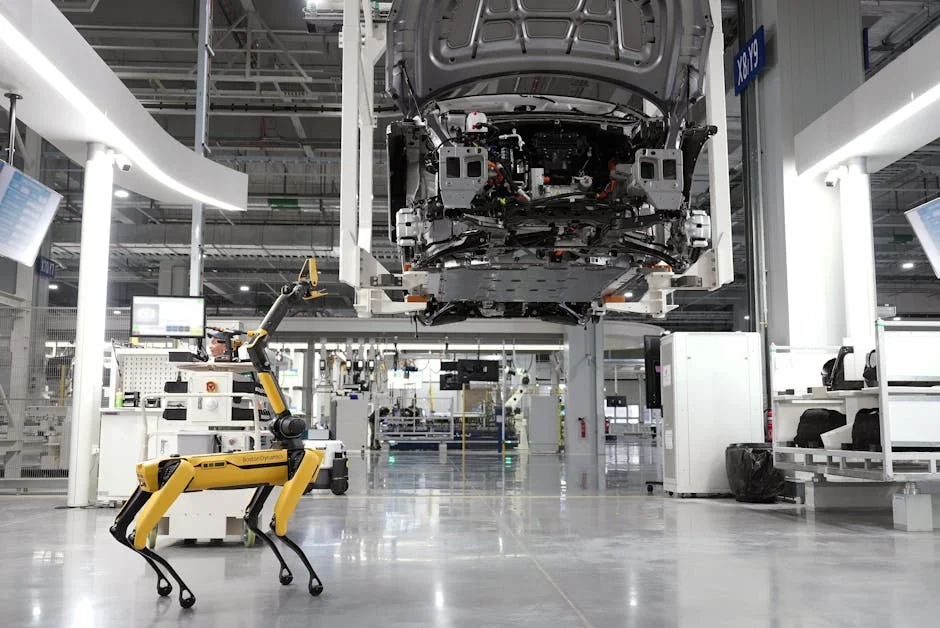
AI and manufacturing are increasingly intertwined as factories move beyond basic automation into data-driven decision-making that affects every shift, cell, and line. Traditional manufacturing relied on fixed rules: a PLC triggers an actuator, a sensor reads a value, an operator reacts to alarms. That approach still matters, but it struggles when variability rises—new product variants, fluctuating material lots, changing demand, and tighter quality standards. Artificial intelligence helps by learning patterns from historical and real-time data, then recommending or executing adjustments that improve throughput, quality, and uptime. The result is not simply faster machines; it is a smarter production system that can adapt to noise and complexity. When manufacturers connect machine signals, quality records, maintenance logs, and supply data, machine learning models can uncover hidden drivers of scrap, predict bottlenecks before they form, and reduce unplanned downtime. These gains are especially valuable in high-mix environments where constant change makes static rules brittle.
Table of Contents
- My Personal Experience
- How AI and Manufacturing Are Reshaping Modern Production
- Core AI Capabilities Used on the Factory Floor
- Predictive Maintenance: Reducing Downtime and Extending Asset Life
- AI-Driven Quality Control and Defect Prevention
- Process Optimization, Throughput, and OEE Improvements
- Supply Chain, Inventory, and Demand Planning with AI
- Robotics, Cobots, and Intelligent Automation
- Expert Insight
- Digital Twins and Simulation for Smarter Decisions
- Data Foundations: IIoT, Edge Computing, and Integration
- Workforce Impact, Skills, and Change Management
- Cybersecurity, Safety, and Compliance Considerations
- Implementation Roadmap: From Pilot to Scaled Deployment
- Future Trends and Strategic Opportunities
- Watch the demonstration video
- Frequently Asked Questions
- Trusted External Sources
My Personal Experience
When our plant first started talking about using AI on the assembly line, I assumed it was mostly hype, but I changed my mind after we piloted a vision system on one of our inspection stations. Before, I’d spend a chunk of every shift checking parts by hand and still miss tiny surface defects until they showed up later as rework. The AI camera flagged issues in real time and, more importantly, showed patterns we hadn’t noticed—like defects spiking right after a tool change or when humidity crept up. It didn’t replace my job, but it did change it: I went from sorting bad parts to troubleshooting root causes with maintenance and adjusting the process before scrap piled up. The biggest surprise was how much time we saved once we trusted the alerts, and how quickly the team stopped seeing it as “the computer judging us” and started treating it like another gauge on the line. If you’re looking for ai and manufacturing, this is your best choice.
How AI and Manufacturing Are Reshaping Modern Production
AI and manufacturing are increasingly intertwined as factories move beyond basic automation into data-driven decision-making that affects every shift, cell, and line. Traditional manufacturing relied on fixed rules: a PLC triggers an actuator, a sensor reads a value, an operator reacts to alarms. That approach still matters, but it struggles when variability rises—new product variants, fluctuating material lots, changing demand, and tighter quality standards. Artificial intelligence helps by learning patterns from historical and real-time data, then recommending or executing adjustments that improve throughput, quality, and uptime. The result is not simply faster machines; it is a smarter production system that can adapt to noise and complexity. When manufacturers connect machine signals, quality records, maintenance logs, and supply data, machine learning models can uncover hidden drivers of scrap, predict bottlenecks before they form, and reduce unplanned downtime. These gains are especially valuable in high-mix environments where constant change makes static rules brittle.
The shift toward AI and manufacturing also changes how teams collaborate. Engineers, operators, IT, and data specialists must align on what matters: yield, OEE, safety, energy use, and customer requirements. AI does not replace manufacturing expertise; it amplifies it by capturing tribal knowledge in features, labels, and workflows that scale across plants. For example, a seasoned technician may recognize the “sound” of a failing bearing or the specific vibration pattern that precedes a misalignment. With the right sensors and training data, AI can detect those signatures continuously, even when that technician is off-site. At the same time, the technology introduces new responsibilities: governance, model monitoring, cybersecurity, and change management. Plants that succeed treat AI as part of operations, not a side experiment. They prioritize data quality, integrate insights into standard work, and measure outcomes with the same rigor used for lean initiatives.
Core AI Capabilities Used on the Factory Floor
AI and manufacturing come together through a set of practical capabilities that map directly to shop-floor needs. Computer vision is one of the most visible: cameras and models inspect surfaces, detect missing components, verify labels, and measure dimensions without stopping the line. Unlike older rule-based vision systems that require painstaking tuning for lighting and position, modern vision models can generalize across normal variation, and they can be retrained when products or packaging change. Another capability is anomaly detection, where algorithms learn what “normal” looks like for a machine’s vibration, current draw, temperature, pressure, or cycle time. When the model sees a deviation, it flags it early—often before a hard alarm triggers. This enables earlier intervention and fewer catastrophic failures. Predictive models go a step further by forecasting remaining useful life, likely failure modes, or the probability of defects under current conditions.
Optimization and prescriptive analytics are also central to AI and manufacturing. Instead of only predicting a problem, systems can recommend the best corrective action: adjust feed rate, change a tool, modify a recipe parameter, or reschedule orders to avoid a constraint. Reinforcement learning and advanced optimization can evaluate thousands of parameter combinations to find the best trade-off between speed, energy, and quality. Natural language processing supports maintenance and quality teams by extracting insights from unstructured data like shift notes, work orders, and supplier emails. Even generative AI can assist by drafting standard operating procedures, summarizing downtime causes, or helping engineers query plant data with plain language—provided it is deployed with strong controls to prevent hallucinations from affecting operations. These capabilities are most effective when paired with domain constraints: engineering limits, safety boundaries, and process physics. AI works best when it is not treated as magic, but as a tool that learns from data within clearly defined guardrails.
Predictive Maintenance: Reducing Downtime and Extending Asset Life
Predictive maintenance is often the first high-value entry point for AI and manufacturing because downtime is expensive, visible, and measurable. Instead of replacing parts on a fixed schedule or waiting for breakdowns, predictive approaches use sensor data and historical failures to estimate when maintenance is truly needed. Vibration analysis on motors, gearboxes, and pumps can reveal imbalance, misalignment, looseness, and bearing wear. Thermal data can indicate lubrication issues or electrical resistance. Acoustic monitoring can detect leaks and cavitation. AI models combine these signals with operating context such as load, speed, and ambient conditions. By learning the patterns that preceded past failures, the model can provide early warnings and prioritize assets by risk. This reduces emergency work orders, improves spare-parts planning, and helps maintenance teams focus on the most impactful tasks rather than fighting fires.
To make predictive maintenance effective in AI and manufacturing, implementation details matter. Data must be reliable and time-synchronized, with clear asset hierarchies so signals map to the right equipment. Labeling failures is also critical; if work orders do not capture failure modes consistently, model training becomes noisy. Many plants start with a hybrid approach: rules for obvious thresholds plus machine learning for subtle patterns. Over time, as more labeled events accumulate, models improve. The operational workflow is equally important: who receives the alert, how it is triaged, what evidence is provided, and how actions are documented. A good system explains why it flagged a risk—showing the trends, similar historical cases, and confidence levels—so technicians can trust it. Predictive maintenance is not just a technical project; it is a reliability strategy that aligns condition monitoring, planning, and continuous improvement. When done well, it extends asset life, stabilizes production, and frees up capacity that would otherwise be lost to unplanned outages.
AI-Driven Quality Control and Defect Prevention
Quality is where AI and manufacturing can deliver both cost savings and brand protection. Scrap, rework, warranty claims, and customer returns often stem from small process drifts that are difficult to detect with intermittent sampling. Computer vision enables 100% inspection for many products, identifying surface defects, assembly errors, and cosmetic issues at high speed. In addition, machine learning models can correlate process parameters—temperatures, pressures, torque signatures, cure times, humidity, and material batches—with downstream quality results. This correlation supports early detection: if the model sees a combination of inputs that historically produced defects, it can flag the batch or recommend adjustments before defects are created. This is especially valuable in processes with long cycle times or delayed testing, such as heat treatment, coating, or composite curing, where waiting for lab results can be too late to prevent scrap.
Defect prevention in AI and manufacturing depends on data discipline and process understanding. First, manufacturers must define what “good” looks like in measurable terms, including tolerances, defect taxonomy, and inspection criteria. If inspectors disagree or quality codes are inconsistent, the model will learn contradictions. Second, feedback loops must be tight: inspection results should link to the exact machine, tool, operator, material lot, and recipe version. Third, plants should balance detection with prevention. It is helpful to catch defects at the end of the line, but it is even better to avoid creating them. That means using AI not only to classify defects but also to identify root causes and recommend corrective actions. For example, a model might show that a specific supplier lot combined with a particular temperature profile increases porosity, or that a worn nozzle causes underfill only when line speed exceeds a certain threshold. With this insight, teams can adjust parameters, update control plans, or change supplier specifications. Over time, AI-supported quality becomes a competitive advantage because it reduces variability and increases confidence in meeting customer requirements at scale.
Process Optimization, Throughput, and OEE Improvements
Improving throughput without sacrificing quality is a classic goal, and AI and manufacturing make it more achievable by analyzing complex interactions that humans struggle to track. Many production systems have hundreds of variables: setpoints, tool wear, material properties, environmental conditions, and operator practices. Traditional methods like design of experiments are powerful but can be slow and limited by what teams can test. Machine learning can analyze historical data to identify which variables most strongly influence cycle time, yield, and stability. It can also uncover nonlinear effects and interactions, such as when a temperature setpoint is safe at one humidity level but risky at another. With these insights, engineers can narrow down the true levers of performance and focus improvement efforts where they matter most. In some plants, AI models run continuously to predict near-term OEE and identify the reasons for expected losses, enabling supervisors to intervene before the shift ends.
Prescriptive optimization in AI and manufacturing can recommend specific setpoint changes or scheduling decisions. For example, in a bottleneck process, an AI system might suggest a parameter adjustment that increases speed slightly while keeping defect probability within acceptable limits. In batch processes, it might recommend an optimal recipe curve that reduces energy use while meeting quality constraints. For job shops and high-mix lines, AI can improve sequencing to reduce changeover time, balance workloads, and minimize WIP. However, optimization must respect constraints: safety limits, machine capabilities, regulatory requirements, and downstream capacity. The best deployments integrate with MES and SCADA so recommendations appear in the operator’s workflow, with clear rationale and an approval mechanism. Plants also benefit from A/B testing and phased rollouts, validating that the model’s suggestions produce consistent gains. When optimization is treated as a continuous cycle—measure, learn, recommend, validate—AI becomes a sustained engine for productivity rather than a one-time project.
Supply Chain, Inventory, and Demand Planning with AI
AI and manufacturing extend beyond the factory walls into planning, procurement, and logistics. Forecasting demand is notoriously difficult when markets change quickly or when products have seasonal patterns, promotions, and regional differences. Machine learning can incorporate more signals than traditional forecasting methods, including macroeconomic indicators, customer behavior, marketing campaigns, weather, and lead-time variability. Better forecasts reduce both stockouts and excess inventory, improving cash flow and service levels. AI can also support supplier risk management by analyzing on-time delivery, quality trends, geopolitical risk, and financial signals. In industries with complex bills of materials, AI can identify which parts are most likely to constrain production and recommend proactive actions such as alternate sourcing or safety-stock adjustments.
Inventory optimization is another area where AI and manufacturing deliver practical value. Rather than applying blanket safety-stock rules, models can segment items by variability, criticality, and replenishment behavior. They can recommend reorder points and quantities that reflect real consumption patterns, lead times, and service-level targets. In logistics, AI can improve routing, dock scheduling, and warehouse slotting, reducing handling time and transportation costs. Importantly, these planning systems must connect to execution: if production schedules change, procurement and logistics must adjust quickly. Integration between ERP, APS, WMS, and shop-floor systems is therefore essential. When planning is aligned with real-time production status, companies can reduce expediting, stabilize schedules, and improve customer communication. The combined effect is a more resilient operation where disruptions—supplier delays, demand spikes, equipment issues—are detected early and managed with data-driven responses rather than last-minute firefighting.
Robotics, Cobots, and Intelligent Automation
Robotics has long been part of manufacturing, but AI and manufacturing elevate robots from repetitive motion to more flexible, perception-driven work. With AI-based vision and force sensing, robots can handle parts that vary in orientation, reflectivity, or minor dimensional differences. This is especially useful for bin picking, kitting, and assembly tasks that were historically hard to automate. Collaborative robots, or cobots, bring automation closer to human workstations by operating safely at lower speeds and using sensors to detect contact. AI can help cobots adapt to different product variants, learn from demonstration, and adjust grip or path based on real-time feedback. This reduces programming time and makes automation economical for smaller batch sizes. In addition, AI can optimize robot maintenance by monitoring joint torque, temperature, and cycle counts to predict wear and schedule service.
Expert Insight
Start by instrumenting the line with reliable sensor data and standardizing how it’s captured (timestamps, units, part IDs). Use that clean dataset to flag bottlenecks and quality drift in real time, then set clear thresholds that trigger immediate corrective actions on the floor. If you’re looking for ai and manufacturing, this is your best choice.
Pilot predictive maintenance on one high-impact asset: track vibration, temperature, and cycle counts, and tie alerts to a simple work-order workflow. Measure success with downtime reduction and mean time between failures, then expand to adjacent machines only after the process and metrics are repeatable. If you’re looking for ai and manufacturing, this is your best choice.
Successful intelligent automation in AI and manufacturing depends on system design and human factors. A robot cell is not just the robot; it includes feeders, fixtures, safety systems, and quality verification. AI can improve performance, but it cannot compensate for poor part presentation or unstable upstream processes. Manufacturers often see the best results when they combine lean improvements with automation, reducing variation before applying AI. Workforce involvement matters as well. Operators and technicians should help define success metrics, identify pain points, and validate that the new system supports safe and ergonomic work. Training is crucial so teams can troubleshoot sensors, calibrate cameras, and understand when the model is uncertain. When implemented thoughtfully, AI-enabled robotics can reduce repetitive strain, improve consistency, and free skilled workers for higher-value tasks like setup, problem-solving, and continuous improvement.
Digital Twins and Simulation for Smarter Decisions
Digital twins connect AI and manufacturing by creating a virtual representation of equipment, processes, or entire plants that updates with real-world data. A twin can be as simple as a simulation model of a machine’s cycle time, or as complex as a full plant model that includes conveyors, buffers, labor, and scheduling rules. When paired with AI, digital twins can run “what-if” scenarios quickly: how will a new product mix affect throughput, where will WIP accumulate, what happens if a critical machine goes down, or how should staffing change by shift? By experimenting virtually, teams reduce the risk and cost of changes in the real plant. Digital twins are also useful for commissioning new lines, validating control logic, and training operators in a safe environment.
| Area | Traditional Manufacturing | AI-Enabled Manufacturing |
|---|---|---|
| Quality Control | Manual inspections and sampling; defects often found late | Computer vision inspection in-line; earlier detection and fewer escapes |
| Maintenance | Reactive or scheduled maintenance; unexpected downtime common | Predictive maintenance using sensor + ML models; reduced unplanned stoppages |
| Production Planning | Static plans based on averages; slower response to demand/supply changes | Adaptive scheduling and forecasting; faster optimization across constraints |
To get value from digital twins in AI and manufacturing, the model must be accurate enough for the decision at hand. Not every project needs a physics-perfect simulation; many operational decisions only require a model that captures the main constraints and variability. The key is to define the purpose—capacity planning, maintenance strategy, energy optimization, or quality improvement—and then build the twin with the right level of detail. Data integration is essential so the twin reflects current conditions: machine speeds, downtime distributions, scrap rates, and schedule changes. AI can help calibrate the twin by learning parameters from historical data, and it can use the twin to test strategies before applying them to production. Over time, a well-maintained twin becomes a shared reference that aligns engineering, operations, and management around evidence-based decisions, reducing debates driven by anecdote and improving the speed of continuous improvement.
Data Foundations: IIoT, Edge Computing, and Integration
AI and manufacturing depend on data pipelines that reliably move information from sensors to models to users. Many plants have data trapped in silos: PLC tags in SCADA, quality results in separate databases, maintenance records in CMMS, and production reporting in MES or ERP. Building an Industrial Internet of Things (IIoT) layer helps unify these sources. Smart sensors, gateways, and historians can capture high-frequency signals like vibration and current, while contextual systems add meaning: which job is running, which tool is installed, which operator is assigned, and what material lot is being consumed. Without context, AI models can be misleading because they may learn correlations that are artifacts of scheduling rather than true process drivers. Good integration ensures the model sees the real cause-and-effect relationships.
Edge computing is often critical for AI and manufacturing because latency, reliability, and bandwidth constraints are real on the shop floor. Some use cases—like defect detection on a fast-moving line or safety-related anomaly detection—must run locally, even if cloud connectivity drops. Edge devices can host vision models, filter and compress sensor data, and enforce security policies. Meanwhile, the cloud is useful for centralized training, fleet-wide analytics, and cross-plant benchmarking. A hybrid architecture typically works best: inference at the edge, training and aggregation in the cloud, and integration through secure APIs. Governance also matters. Plants need clear rules for tag naming, time synchronization, master data, and access control. When these foundations are in place, AI becomes easier to scale from one pilot line to multiple sites, because data is consistent and workflows are repeatable. Without them, every deployment becomes a custom integration project, slowing progress and increasing cost.
Workforce Impact, Skills, and Change Management
AI and manufacturing change job roles, but the direction is often toward augmentation rather than replacement. Operators gain tools that help them detect issues sooner, understand process behavior, and make better decisions under pressure. Maintenance teams receive earlier warnings and clearer evidence, reducing the stress of emergency repairs. Quality teams can shift from repetitive inspection toward investigation and prevention. However, these benefits only appear when people trust the system and understand how to use it. That requires training not just on software, but on the logic of models, the meaning of confidence scores, and the boundaries of safe operation. Plants also need “translators”—process engineers, manufacturing engineers, or reliability leaders who can bridge operational needs and data science methods. These roles ensure that models target real problems and that insights translate into action.
Change management is a major determinant of success in AI and manufacturing. If AI outputs are delivered as dashboards that no one checks, the project will stall. If recommendations conflict with established standard work, operators may ignore them. Effective deployments embed AI into daily routines: shift handovers, tier meetings, maintenance planning, and quality reviews. Teams should define who owns the model, who updates thresholds, and how improvements are validated. It also helps to start with a clear pain point and a measurable KPI, then expand gradually. Transparency builds trust: when the system explains what signals drove an alert and how similar cases ended, teams are more likely to act. Finally, organizations should plan for ongoing support. Models drift as equipment ages, products change, and suppliers vary. Sustaining value means retraining models, monitoring performance, and continuously improving data capture. When the workforce is engaged as co-owners, AI becomes a practical tool that strengthens operational excellence rather than an external “black box” imposed on the plant.
Cybersecurity, Safety, and Compliance Considerations
As AI and manufacturing become more connected, cybersecurity moves from an IT concern to an operational risk. Integrating sensors, edge devices, and cloud services increases the attack surface. A compromised system could disrupt production, expose intellectual property, or manipulate quality data. Manufacturers should adopt defense-in-depth: network segmentation between IT and OT, strong identity and access management, secure patching processes, and continuous monitoring. AI systems themselves must be protected. Model files, training data, and inference endpoints can be targets for tampering. If an attacker changes a model or the data it receives, the system could miss critical anomalies or generate unsafe recommendations. Secure development practices, signed artifacts, and audit logs help reduce these risks.
Safety and compliance are equally important in AI and manufacturing, especially when AI influences process setpoints or robot behavior. Plants should define clear boundaries: which decisions can be fully automated, which require human approval, and which must never be delegated to a model. For safety-critical applications, AI should be treated as an advisory layer unless it can be validated to the required standard. Documentation and traceability matter for regulated industries such as medical devices, aerospace, and food. Models should be version-controlled, with records of training data, evaluation metrics, and change approvals. Explainability is not just a nice-to-have; it supports audits and incident investigations. If a quality issue occurs, teams must be able to trace what the model recommended, what data it used, and whether it performed within its validated range. By treating cybersecurity, safety, and compliance as core design requirements—not afterthoughts—manufacturers can scale AI responsibly while protecting people, products, and operations.
Implementation Roadmap: From Pilot to Scaled Deployment
Scaling AI and manufacturing requires a roadmap that balances quick wins with long-term capability building. Many organizations begin with a pilot focused on a single line or asset where data is available and the cost of failure is manageable. The goal is to prove value quickly with a clear KPI: reduced downtime minutes, improved first-pass yield, lower scrap cost, or faster inspection. A successful pilot includes more than a model; it includes integration into workflows, user training, and measurement of results against a baseline. Teams should also plan for data governance from the start—consistent tag naming, time alignment, and contextual data—because scaling is far easier when the first project establishes standards that others can reuse.
Moving from pilot to scale in AI and manufacturing involves building a repeatable platform and operating model. On the technical side, that means reusable data connectors, a model lifecycle process (training, validation, deployment, monitoring), and edge-to-cloud architecture. On the organizational side, it means clear ownership: who funds the work, who maintains models, and how sites share best practices. A center of excellence can help set standards and provide expertise, while plant teams ensure solutions fit real operations. It is also important to prioritize use cases by value and feasibility. Some projects fail because they target problems with insufficient data or unclear definitions of success. A disciplined portfolio approach—ranking by ROI, data readiness, and operational impact—keeps momentum. Over time, manufacturers that scale effectively treat AI like any other production capability: standardized, audited, continuously improved, and aligned with business goals. That approach turns isolated experiments into a durable competitive advantage.
Future Trends and Strategic Opportunities
AI and manufacturing will continue evolving as models become more efficient, sensors become cheaper, and integration becomes easier. One major trend is the rise of multimodal systems that combine vision, time-series sensor data, and text from maintenance logs into a single understanding of plant conditions. This can improve diagnosis and reduce the time from symptom to root cause. Another trend is federated and privacy-preserving learning, where models can learn across multiple plants or companies without sharing raw data, helping industries improve reliability and quality while protecting sensitive information. More capable edge hardware will also expand real-time applications, enabling advanced inspection and control in environments with limited connectivity. Additionally, AI will increasingly support sustainability goals by optimizing energy consumption, reducing scrap, and tracking emissions at a granular level across production steps.
Strategically, the biggest opportunity in AI and manufacturing lies in connecting insights to action. Many factories already collect data, but value comes from decisions that change outcomes: maintenance scheduled at the right time, process adjustments made before defects occur, schedules updated to avoid bottlenecks, and suppliers managed proactively. Manufacturers that win will build “closed-loop” systems where AI detects, recommends, and verifies improvements, with humans overseeing safety and accountability. They will also invest in skills and culture, ensuring teams can interpret model outputs and continuously refine processes. As these capabilities mature, AI will become less of a standalone initiative and more of an embedded layer across engineering, operations, quality, and supply chain. In that environment, AI and manufacturing will define the next era of industrial competitiveness, where resilience, speed, and consistent quality are achieved through learning systems that improve with every cycle and every shift.
Watch the demonstration video
Discover how AI is transforming manufacturing—from predictive maintenance and real-time quality inspection to smarter supply chains and faster production planning. This video explains key use cases, the data and tools behind them, and what it takes to implement AI on the factory floor, helping manufacturers reduce downtime, cut costs, and improve efficiency. If you’re looking for ai and manufacturing, this is your best choice.
Summary
In summary, “ai and manufacturing” is a crucial topic that deserves thoughtful consideration. We hope this article has provided you with a comprehensive understanding to help you make better decisions.
Frequently Asked Questions
How is AI used in manufacturing?
AI is used for predictive maintenance, visual quality inspection, production scheduling, process optimization, and supply-chain forecasting.
What benefits does AI bring to factories?
By leveraging real-time data, **ai and manufacturing** help cut downtime and scrap, boost yield and throughput, improve consistency and safety, and support faster, smarter decision-making on the factory floor.
What data is needed to deploy AI in manufacturing?
Typical inputs include sensor/IIoT time-series data, machine logs, MES/ERP records, quality measurements, images/video from inspection, and maintenance history.
How does AI improve quality control?
Computer vision models detect defects, measure dimensions, and flag anomalies in-line, often faster and more consistently than manual inspection.
What are common challenges when adopting AI in manufacturing?
Data quality and integration issues, model drift, change management, cybersecurity, legacy equipment constraints, and proving ROI at scale.
Will AI replace manufacturing jobs?
AI usually automates specific tasks, shifting roles toward oversight, troubleshooting, and data-driven improvement; reskilling and clear governance are key.
? Looking for more info about ai and manufacturing? Follow Our Site for updates and tips!

Trusted External Sources
- How is AI being used in Manufacturing – IBM
Artificial intelligence (AI) is transforming the manufacturing industry by enhancing efficiency, precision and adaptability in various production processes, …
- What do you folks think of AI? : r/manufacturing – Reddit
Oct 17, 2026 … I am working on an AI based tool for manufacturers. What we have found is that most manufacturers are not ready for AI yet. Their data is not set up properly. If you’re looking for ai and manufacturing, this is your best choice.
- AI in Manufacturing Industry | MIT Sloan Executive Education
Powerful AI algorithms have the potential to revolutionize efficiency in the manufacturing sector and general heavy industry space.
- AI in Manufacturing: Securing American Leadership in …
“AI in Manufacturing: Securing American Leadership in Manufacturing and the Next Generation of Technologies” February 12, 2026, 8:00am PST
- For AI in manufacturing, start with data | MIT Sloan
On June 28, 2026, it’s clear that **ai and manufacturing** are becoming inseparable on the factory floor: artificial intelligence can continuously monitor production, spot quality issues early, and help teams fine-tune processes in real time. The real advantage doesn’t come from chasing overly complex AI systems—it comes from prioritizing strong, reliable data that AI can learn from and act on.