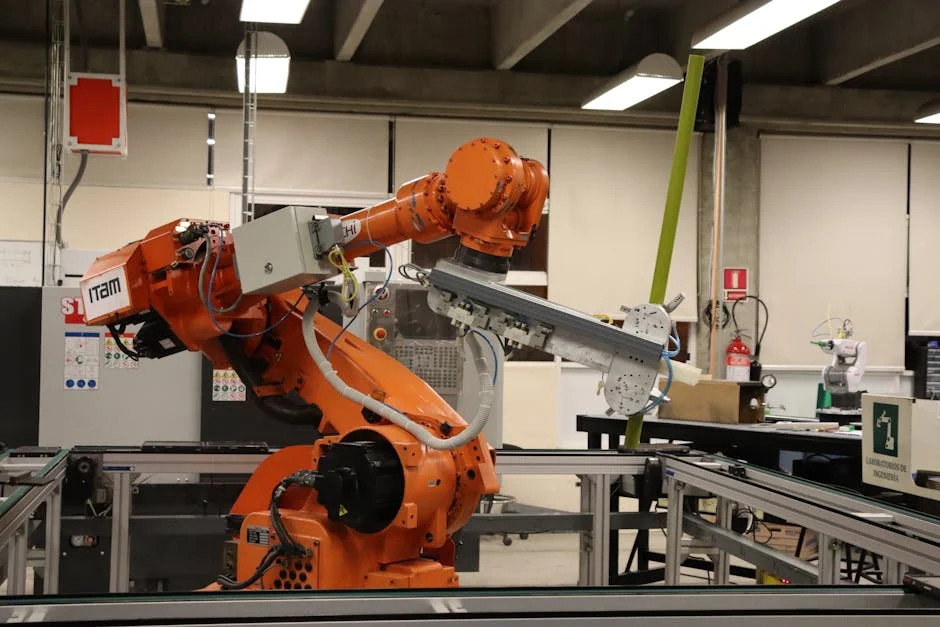
An industrial robot arm has become a defining piece of modern manufacturing because it brings repeatable motion, consistent quality, and scalable output to environments where speed and precision are non-negotiable. In practical terms, a robot arm is a programmable mechanical manipulator with joints that mimic a human shoulder, elbow, and wrist, but it operates with the endurance and accuracy of a machine. Factories rely on it to weld, pick and place, palletize, assemble, polish, paint, and handle materials that are heavy, hot, sharp, or simply too repetitive for human workers to perform safely over long shifts. The value is not limited to high-volume automotive lines; electronics, food packaging, medical devices, plastics, and metal fabrication all benefit when a robotic arm can keep cycle times stable while maintaining tight tolerances. What makes the industrial robot arm uniquely powerful is its blend of mechanical design, servo control, sensors, and software: each joint is driven by motors and gearboxes, monitored by encoders, and coordinated by a controller that executes motion paths with careful acceleration and deceleration. This coordination allows the arm to move smoothly through a sequence of points, follow a continuous curve, or synchronize with conveyors and vision systems. When a process demands consistent bead geometry in welding, accurate placement of small components, or careful handling of fragile products, robotic manipulation becomes a competitive advantage rather than a luxury.
Table of Contents
- My Personal Experience
- Industrial Robot Arm Basics and Why They Matter
- Core Components: Mechanics, Drives, and Control Architecture
- Types of Industrial Robot Arms and Their Best-Fit Use Cases
- Key Specifications: Payload, Reach, Repeatability, and Cycle Time
- End-of-Arm Tooling: Grippers, Welding Torches, and Process Tools
- Programming and Motion Planning: From Teaching to Offline Simulation
- Industrial Robot Arm Applications Across Major Industries
- Expert Insight
- Safety, Risk Assessment, and Compliance in Robot Cells
- Integration with Vision, Sensors, and Industrial Networks
- Maintenance, Reliability, and Total Cost of Ownership
- Implementation Strategy: From Proof of Concept to Scaled Deployment
- Future Trends: Smarter Robotics, AI Assistance, and Flexible Manufacturing
- Watch the demonstration video
- Frequently Asked Questions
- Trusted External Sources
My Personal Experience
The first time I worked with an industrial robot arm was during a short stint on a packaging line, and I remember being surprised by how “alive” it felt even though it was just following code. My job was mostly setup and troubleshooting: teaching a few pick-and-place points, checking the gripper pressure, and making sure the parts were consistently oriented on the conveyor. One afternoon it started missing every third pick, and after a lot of guessing I finally noticed a tiny film of oil on the suction cup that was enough to break the seal. Cleaning it took two minutes, but it taught me how small, real-world details can throw off a system that looks perfect on a screen. By the end of the week I trusted the arm’s repeatability more than my own hands—while also respecting how quickly it can go from “smooth” to “dangerous” if you get careless around it.
Industrial Robot Arm Basics and Why They Matter
An industrial robot arm has become a defining piece of modern manufacturing because it brings repeatable motion, consistent quality, and scalable output to environments where speed and precision are non-negotiable. In practical terms, a robot arm is a programmable mechanical manipulator with joints that mimic a human shoulder, elbow, and wrist, but it operates with the endurance and accuracy of a machine. Factories rely on it to weld, pick and place, palletize, assemble, polish, paint, and handle materials that are heavy, hot, sharp, or simply too repetitive for human workers to perform safely over long shifts. The value is not limited to high-volume automotive lines; electronics, food packaging, medical devices, plastics, and metal fabrication all benefit when a robotic arm can keep cycle times stable while maintaining tight tolerances. What makes the industrial robot arm uniquely powerful is its blend of mechanical design, servo control, sensors, and software: each joint is driven by motors and gearboxes, monitored by encoders, and coordinated by a controller that executes motion paths with careful acceleration and deceleration. This coordination allows the arm to move smoothly through a sequence of points, follow a continuous curve, or synchronize with conveyors and vision systems. When a process demands consistent bead geometry in welding, accurate placement of small components, or careful handling of fragile products, robotic manipulation becomes a competitive advantage rather than a luxury.
Beyond speed, the industrial robot arm matters because it reshapes how production capacity is planned and how quality is measured. A well-integrated robot does not “get tired,” so process drift caused by fatigue is reduced, and output becomes easier to forecast. That predictability makes it simpler to manage inventory, meet delivery windows, and standardize products across multiple plants. The robot arm also supports traceability and data collection: controllers can log cycle counts, fault codes, torque values, and process signals, enabling more rigorous quality control and preventive maintenance. At the same time, real-world deployment is not only about buying a machine; it involves choosing the right kinematics, payload, reach, and end-of-arm tooling, plus ensuring guarding, risk assessments, and operator training. Some facilities adopt a robotic arm to solve a specific bottleneck, while others build an automation roadmap that starts with a single cell and expands to a fleet. Either way, the core idea remains the same: a robot arm is a production resource that executes defined motion reliably and can be reprogrammed as products evolve, allowing manufacturers to adapt faster than fixed-purpose machinery.
Core Components: Mechanics, Drives, and Control Architecture
The performance of an industrial robot arm is the result of tightly integrated components that translate digital commands into physical motion. Mechanically, the arm is built from links and joints, typically offering four to seven axes of movement. Each axis includes a motor, a transmission (often a harmonic drive, cycloidal reducer, or precision gearbox), and feedback devices such as absolute or incremental encoders. These parts determine repeatability, stiffness, and dynamic behavior. A stiff structure helps the robot arm maintain accuracy under load, while a well-matched drive train reduces backlash and improves path fidelity. The base is designed to anchor the arm to a floor, pedestal, wall, or overhead mount, and internal cable routing often protects wires and hoses from abrasion. Counterbalancing mechanisms, brakes on vertical axes, and thermal management all contribute to safe and reliable operation, especially when the robotic arm carries heavy payloads or cycles rapidly. The wrist assembly is particularly important because it governs orientation control; applications like arc welding, dispensing, and machining-like finishing depend on stable tool angles and smooth rotation around multiple axes.
Control architecture is equally essential to how an industrial robot arm behaves on the factory floor. The controller is typically an industrial computer with real-time motion control, safety-rated I/O, and communication interfaces for PLCs, fieldbuses, and Ethernet-based protocols. Servo drives regulate motor torque and speed, while the robot’s motion planner converts a program into coordinated joint trajectories that respect limits such as maximum velocity, acceleration, and jerk. Advanced controllers include features like collision detection, torque limiting, and model-based control that compensates for gravity and dynamic loads. Many robot arms support different motion types: point-to-point for fast repositioning, linear moves for straight-line toolpaths, and circular interpolation for arcs. Calibration routines and mastering procedures ensure the controller’s internal model matches the physical joint positions, which is critical for accuracy. Integration with peripherals expands capability: vision systems can provide part location updates, force/torque sensors enable compliant insertion, and external axes like rotary tables extend reach and flexibility. When these components are selected and tuned correctly, the robotic arm becomes a stable platform for automation rather than a source of unpredictable downtime.
Types of Industrial Robot Arms and Their Best-Fit Use Cases
Choosing an industrial robot arm starts with understanding the main kinematic families and what each does best. Articulated robots, typically with six axes, are the most common because they offer a wide working envelope and can orient tools in complex ways. They excel in welding, machine tending, packaging, and general assembly, especially when parts must be approached from different angles. SCARA robots, with a selective compliance design, are optimized for fast, planar motion and are widely used for high-speed pick-and-place, electronics assembly, and light-duty handling. Cartesian and gantry systems move along linear axes and are valued for their straightforward programming, high stiffness, and large rectangular workspaces; they frequently appear in palletizing, CNC loading, and large-area dispensing. Delta robots, with parallel kinematics, deliver extreme speed and are often chosen for sorting and picking small items on conveyors, especially in food and consumer goods packaging where throughput is critical. Each architecture changes how the robot arm approaches payload, reach, cycle time, and accuracy, and those tradeoffs guide selection.
Beyond kinematics, industrial robot arms are categorized by payload class and environmental suitability. Small payload robotic arms handle delicate components and can be paired with compact grippers and vision for electronics, medical device assembly, and laboratory automation. Mid-range robot arms often serve as versatile workhorses for welding, tending, and packaging. Heavy-duty arms can lift hundreds of kilograms, enabling large part handling, die casting extraction, and heavy palletizing. Environmental ratings matter: foundry variants include heat shielding and sealed joints; cleanroom robots use special lubricants and low-particle designs; washdown models resist corrosion for food and beverage plants. There is also a distinction between traditional industrial robots and collaborative designs that incorporate force limiting and safety-rated monitoring to work closer to humans. Even when collaboration is not the goal, features like compact footprints, longer reaches, hollow wrists, and integrated dress packs can simplify cell design. Matching a robotic arm to a use case is less about buying “the best robot” and more about selecting the right combination of kinematics, payload, reach, and protection so the process can run consistently under real production conditions.
Key Specifications: Payload, Reach, Repeatability, and Cycle Time
Evaluating an industrial robot arm requires translating marketing numbers into practical performance for a specific task. Payload is not only the weight of the part; it includes the end effector, brackets, cables, vacuum generators, and any compliance devices. Equally important is the payload’s center of gravity and inertia, because a long, offset tool can stress the wrist and reduce achievable speed. Reach defines how far the robot arm can extend, but the shape of the work envelope matters too; some robots have excellent forward reach but limited ability to work close to the base or behind themselves. Repeatability is often more relevant than absolute accuracy in many automation tasks: repeatability describes how closely the robot can return to a taught position over many cycles. For operations like spot welding or pick-and-place, high repeatability supports consistent outcomes, while absolute accuracy becomes critical when the robot must hit a coordinate derived from CAD data without extensive teaching. Cycle time depends on motion limits, path complexity, payload, and how the program is written; a robot arm might appear fast on a standard test, yet slow down significantly when asked to follow a precise path with smooth orientation changes.
Additional specifications shape how an industrial robot arm behaves in daily production. Joint speed and acceleration influence throughput, but they also affect vibration and settling time, especially with long tools. Wrist torque ratings are crucial for processes that apply force, such as polishing or screwdriving, where the arm must resist reaction forces. Mounting options determine whether the robot can be installed on a wall, ceiling, or angled base, which can free floor space and improve access. Protection ratings like IP levels indicate resistance to dust and liquids, and they should match the environment, particularly in cutting fluids, paint booths, or washdown zones. Communication and I/O capacity matter for integration: the robot arm must exchange signals with PLCs, safety controllers, vision systems, and process equipment. Finally, serviceability and spare parts availability affect total cost of ownership; a robot with readily available reducers, cables, and taught pendant components can reduce downtime over the years. By treating these specifications as a system rather than isolated numbers, buyers can avoid common pitfalls like underestimating tooling weight, overestimating reachable points, or ignoring environmental factors that shorten component life.
End-of-Arm Tooling: Grippers, Welding Torches, and Process Tools
The capabilities of an industrial robot arm are ultimately expressed through end-of-arm tooling (EOAT), the device attached to the wrist that interacts with the product. For material handling, EOAT commonly includes parallel grippers, angular grippers, vacuum cups, magnetic grippers, and specialized fingers shaped to a part’s geometry. A robot arm can switch between tools using automatic tool changers, enabling a single cell to run multiple SKUs or perform sequential operations such as picking, orienting, and placing. Successful gripper design balances holding force, part protection, and tolerance variation. For example, vacuum tooling can be fast and gentle but may struggle with porous surfaces or dusty environments; mechanical grippers provide strong retention but require careful finger geometry to avoid marring. Sensors such as part-present switches, vacuum pressure monitoring, and proximity detectors improve reliability by confirming that the robotic arm has actually secured the part before moving at speed. Cable management, air lines, and electrical routing must be planned so the arm can complete its full range of motion without snagging or fatigue failures.
Process tooling expands what an industrial robot arm can do beyond pick-and-place. In welding, the robot arm may carry a MIG torch, spot welding gun, or laser head, each requiring precise path control and stable orientation. In dispensing and sealing, the tool might be a metering valve that demands consistent speed to maintain bead width, along with temperature control for adhesives. For sanding, polishing, and deburring, the EOAT may incorporate compliance to maintain consistent contact force, and dust extraction to manage particulates. Painting and coating tools require attention to atomization, fluid routing, and explosion-proof considerations, often paired with specialized robot variants. Screwdriving and press-fit insertion benefit from torque feedback and force sensing, allowing the robotic arm to detect cross-threading or misalignment. Even inspection tasks can be handled with cameras, laser profilers, or touch probes mounted on the wrist. Because EOAT is application-specific, it often determines whether a robot project succeeds: a high-quality robot arm paired with a poorly designed gripper can create dropped parts, jams, and downtime, while thoughtful tooling can make even a modest robot perform reliably at production scale.
Programming and Motion Planning: From Teaching to Offline Simulation
Programming an industrial robot arm can range from simple teaching to advanced offline workflows, depending on complexity and changeover frequency. Traditional teaching uses a pendant to jog the robot to positions and record points, building a sequence of moves with speeds, approach distances, and I/O triggers. This method is intuitive for straightforward pick-and-place or palletizing, and it allows technicians to refine paths directly on the shop floor. However, it can be time-consuming when many points are required, and it may interrupt production if the robot must be taken offline for adjustments. Modern controllers support structured programming with variables, subroutines, and conditional logic, enabling a robot arm to handle multiple part variants, respond to sensors, and recover from faults. Palletizing wizards, welding packages, and vision-guided routines can accelerate deployment, but they still require careful validation to ensure paths are safe, collision-free, and optimized for cycle time.
Offline programming and simulation have become important tools for maximizing industrial robot arm uptime. With offline software, engineers can build a digital cell that includes fixtures, conveyors, safety zones, and the robot arm itself, then generate paths and check for collisions before anything is installed. This approach is particularly useful for welding and complex assembly, where tool orientation and reach constraints can cause unexpected problems. Offline programming also supports faster changeovers: when a new product is introduced, paths can be developed and tested virtually, then downloaded during planned downtime. Accurate simulation depends on correct models of the robot, EOAT, and workpieces, as well as calibration between the virtual coordinates and the physical cell. Techniques such as 3D vision localization, calibration plates, and robot kinematic calibration help align the digital and real-world frames. Motion planning considerations include blending between moves to reduce stops, controlling jerk to minimize vibration, and maintaining constant tool speed for processes like dispensing. When programming is treated as a disciplined engineering activity rather than ad hoc point teaching, the robot arm becomes easier to maintain, easier to scale, and less prone to unpredictable behavior when production demands change.
Industrial Robot Arm Applications Across Major Industries
Industrial robot arm adoption spans a wide range of industries because the core benefits—repeatability, speed, and controlled motion—apply to many production challenges. In automotive manufacturing, robot arms are synonymous with welding, sealing, and painting, but they also handle battery module assembly, adhesive dispensing, and machine tending. In metal fabrication, robotic welding cells improve consistency, reduce rework, and help address skilled welder shortages by shifting human expertise toward programming, fixturing, and inspection. Electronics manufacturing relies on fast, precise robotic arms for placing components, handling trays, applying thermal interface materials, and performing automated optical inspection with camera payloads. In plastics and injection molding, a robot arm can extract parts, trim gates, and stage components for downstream packaging, often operating in high-temperature environments where manual extraction is risky. Food and beverage plants use robotic arms for case packing, sorting, and palletizing, where washdown designs and hygienic tooling are critical. Even woodworking and furniture production benefit from robot-guided sanding and spraying when consistent surface finish and efficient material usage are priorities.
| Robot Arm Type | Best For | Key Trade‑offs |
|---|---|---|
| Articulated (6‑axis) | General-purpose automation: welding, machine tending, assembly, palletizing | High flexibility and reach; larger footprint and more complex programming than simpler arms |
| SCARA | High-speed pick-and-place, small-part assembly, packaging | Very fast and repeatable in a plane; limited vertical/3D dexterity and reach vs 6‑axis |
| Collaborative (Cobot) | Human-robot shared workspaces, light assembly, inspection, screwdriving | Easier deployment and safer interaction; typically lower speed/payload and may require safety validation |
Expert Insight
Start by matching the industrial robot arm to the job’s real demands: payload at full reach, required cycle time, and the exact tool weight (including cables and grippers). Build in a safety margin and validate with a simple reach-and-collision check so the arm can hit every point without awkward joint limits or reduced speed.
Protect uptime with a maintenance routine that targets the common failure points: keep dress packs and cable routing strain-free, verify repeatability with a quick reference fixture, and track vibration/temperature trends on key joints. Standardize spare parts (belts, seals, encoders) and document recovery steps so operators can restore production quickly after a stop. If you’re looking for industrial robot arm, this is your best choice.
Application success depends on tailoring the industrial robot arm cell to the product and process constraints. For example, in palletizing, the robot arm must handle varying box sizes, maintain stable stacking patterns, and coordinate with pallet dispensers and stretch wrappers. In machine tending, the arm must interface with CNC doors, clamps, and part probing cycles, often requiring robust error handling when a part is misloaded or a chuck does not clamp correctly. In assembly, the robot may need compliance and sensing to insert parts without jamming, especially when tolerances stack up. In inspection, a robot arm can move a camera to multiple viewpoints, but lighting control and vibration management become critical to image quality. In hazardous environments, robotic manipulation reduces exposure to fumes, heat, and repetitive strain. Across all these scenarios, the robot arm is rarely a standalone machine; it is part of an integrated system with fixtures, sensors, safety hardware, and quality checks. The strongest deployments focus on process stability first—consistent part presentation, reliable fixturing, and clear acceptance criteria—then leverage the robot’s speed and precision to deliver measurable improvements in throughput and defect reduction.
Safety, Risk Assessment, and Compliance in Robot Cells
Safety is central to any industrial robot arm deployment because robotic motion can be fast, powerful, and unforgiving of unexpected human presence. A proper risk assessment evaluates hazards such as crushing, impact, pinch points, sharp tooling, hot processes, and stored energy in pneumatic or hydraulic circuits. Traditional robot cells often use perimeter guarding with interlocked doors, light curtains, area scanners, and safety-rated stop circuits to prevent entry while the robot arm is in automatic mode. Safety controllers and safety PLCs monitor e-stops, gate switches, enabling devices, and safe speed functions. Many modern robot systems also support safety-rated monitored stop, safe limited speed, safe position, and safe torque off, allowing more flexible operation modes for setup and maintenance. Even when a collaborative-style approach is used, the process tool may introduce hazards that require guarding; a robot arm carrying a sharp knife, hot welder, or high-force press tool cannot be treated like a low-risk application simply because the robot has force limiting features.
Compliance involves adhering to relevant standards and documenting that the industrial robot arm cell has been designed, installed, and validated responsibly. This typically includes establishing safety zones, defining operating modes, and providing clear procedures for lockout/tagout, tool changes, and maintenance. Training is a practical part of compliance: operators need to understand how to stop the robot arm safely, what alarms mean, and how to handle routine interruptions like part replenishment. Maintenance staff must know how to isolate energy sources and verify safe states before entering the cell. Integrators often provide a safety manual, wiring schematics, and validation test results for protective devices. Good safety design also considers ergonomics and human factors: placing HMIs where they are visible, designing fixtures that minimize awkward reaches, and ensuring that recovery from faults does not encourage unsafe shortcuts. When safety is engineered from the beginning, production can run with fewer interruptions, fewer near-misses, and clearer accountability. The result is a robotic arm installation that supports productivity without compromising the well-being of the people working around it.
Integration with Vision, Sensors, and Industrial Networks
Adding perception and feedback transforms an industrial robot arm from a repeatable mover into a more adaptable automation platform. Vision systems can locate parts on a conveyor, identify orientation, read barcodes, and verify presence before the robot arm attempts a pick. 2D vision is common for planar tasks, while 3D vision supports bin picking and complex pose estimation. The quality of vision-guided robotics depends on lighting, lens selection, camera mounting rigidity, and calibration between camera coordinates and robot coordinates. Force/torque sensors mounted at the wrist allow the robot arm to perform compliant tasks such as insertion, polishing, and delicate handling, where the robot reacts to contact forces instead of pushing blindly. Proximity sensors, laser distance sensors, and tactile switches can provide additional confirmation of part position and fixture state, reducing the chance of collisions or misassemblies. These sensors also enable smarter recovery: if a pick fails, the robot arm can attempt a regrip or notify an operator with actionable diagnostics rather than stopping with a generic fault.
Industrial networking ties the robot arm into the broader production system. Communication with PLCs, conveyors, safety systems, and MES platforms enables synchronized operation and data exchange. Fieldbus and industrial Ethernet protocols allow deterministic control signals, recipe selection, and status monitoring. For example, a robot arm in a machine tending cell may receive a “machine ready” signal, exchange part ID data, and report cycle completion and quality results back to a line controller. Networked robots also support condition monitoring by publishing temperature, motor load, and alarm history, which can feed predictive maintenance programs. Integration must be engineered carefully: poor signal design can create race conditions where the robot arm and a peripheral device wait on each other, causing intermittent downtime that is difficult to troubleshoot. Robust handshaking, timeouts, and clear state machines improve reliability. Cybersecurity is also relevant; robot controllers are computers on a network, so access control, segmented networks, and secure remote support practices help reduce risk. When sensors and networking are planned holistically, the robot arm becomes a connected asset that supports both operational performance and long-term improvement initiatives. If you’re looking for industrial robot arm, this is your best choice.
Maintenance, Reliability, and Total Cost of Ownership
Long-term value from an industrial robot arm depends on maintenance discipline and realistic planning for wear components. Robot arms contain reducers, bearings, belts, cables, and seals that experience fatigue over millions of cycles. Preventive maintenance typically includes lubrication checks, grease changes at specified intervals, inspection of cable dress packs, verification of backlash and mastering, and cleaning of fans and filters in the controller cabinet. Harsh environments accelerate wear; abrasive dust can compromise seals, coolant mist can degrade cables, and heat can shorten electronics life. Downtime is often caused not by the robot arm itself but by peripheral failures such as gripper leaks, sensor misalignment, or fixture wear, so a complete maintenance plan should cover the entire cell. Keeping critical spares—like wrist cables, teach pendant components, fuses, and key pneumatic parts—can reduce the time to recover from failures. Logging alarms and analyzing repeat faults helps identify whether issues are caused by programming, mechanical wear, or process instability.
Total cost of ownership includes more than the purchase price of the industrial robot arm. Integration costs—tooling, guarding, safety devices, fixtures, conveyors, and engineering time—often exceed the robot cost itself. Operating costs include energy, consumables, spare parts, and labor for maintenance and programming. The best TCO outcomes come from designing for serviceability: quick access to tooling, standardized sensors, modular grippers, and clear wiring labels. Selecting a robot arm with local service support and a strong parts supply chain can matter more than small differences in list price. Training is another TCO lever: when technicians can troubleshoot the robot and adjust programs internally, the facility avoids repeated service calls for minor changes. Uptime metrics such as MTBF and MTTR provide a practical lens; a slightly more expensive robot arm that is easier to maintain and faster to repair may be cheaper over its lifecycle. By treating maintenance as part of the production system, rather than an afterthought, manufacturers can keep robotic assets productive for many years while maintaining consistent quality and predictable output.
Implementation Strategy: From Proof of Concept to Scaled Deployment
Successful industrial robot arm projects often follow a staged implementation strategy that reduces risk and builds internal capability. A proof of concept can validate that parts can be picked reliably, that cycle time targets are realistic, and that the process is stable enough for automation. This stage frequently reveals upstream issues such as inconsistent part presentation, variable material quality, or inadequate fixturing. Addressing those issues early prevents the robot arm from becoming a “bandage” over a weak process. Once feasibility is confirmed, detailed cell design begins: layout, guarding, tool design, cable routing, pneumatic and electrical requirements, and control architecture. Simulation and reach studies help ensure that the robot arm can access all required positions without singularities or collisions. Clear acceptance criteria are essential, including throughput, scrap rate, uptime targets, and quality measurements. A structured commissioning plan then verifies I/O, safety functions, motion paths, and process parameters in a logical sequence, reducing chaotic debugging on the production floor.
Scaling from one industrial robot arm cell to multiple cells requires standardization and documentation. Standard electrical schematics, common sensor families, reusable software blocks, and consistent naming conventions make it easier to replicate success. Recipe management becomes important when multiple products run on the same robot arm; operators need simple selection mechanisms and clear instructions for changeover. Performance monitoring should be built in: cycle counts, downtime reasons, and quality outcomes provide feedback for continuous improvement. Workforce planning is part of scaling as well; technicians, engineers, and operators need training that matches their responsibilities, from basic recovery to advanced programming. Vendor and integrator relationships also matter: consistent support, spare parts availability, and software licensing models can affect expansion plans. A thoughtful roadmap might begin with a high-ROI application like palletizing or machine tending, then move into more complex tasks like assembly with force sensing. With each deployment, the organization learns how to design fixtures better, tune motion faster, and maintain the robot arm more effectively, turning automation into a repeatable capability rather than a one-time project.
Future Trends: Smarter Robotics, AI Assistance, and Flexible Manufacturing
The industrial robot arm is evolving from a fixed automation tool into a more flexible, data-driven production resource. One trend is improved ease of use: graphical programming interfaces, guided setup routines, and higher-level motion commands reduce the barrier for creating robust robot programs. Another trend is tighter integration with vision and AI-based perception, enabling robotic arms to handle greater variation in part position and appearance. This is especially relevant for bin picking, kitting, and mixed-product lines where traditional hard fixturing is expensive or impractical. Advanced motion control continues to improve path accuracy and speed while limiting vibration, which benefits processes like dispensing, laser cutting, and finishing. Digital twins and connected analytics are also becoming more common, allowing engineers to compare expected cycle times with real performance, detect anomalies, and plan maintenance based on actual usage patterns rather than fixed intervals. These capabilities help keep robot arm fleets productive and reduce unplanned downtime.
Flexible manufacturing is pushing industrial robot arm deployments toward modular cells that can be reconfigured quickly. Quick-change tooling, standardized pallets, and mobile bases can allow a robot arm to be redeployed as demand shifts. Human-robot collaboration concepts are also expanding, not only through force-limited robots but through safer cell designs where people and robot arms share adjacent tasks with clear separation of responsibilities. Another direction is sustainability: robot-optimized processes can reduce scrap, improve material usage, and support energy-efficient production by stabilizing cycle times and minimizing rework. As labor markets tighten and product lifecycles shorten, manufacturers increasingly value automation that can adapt rather than only automate one fixed part. The most practical future for the robot arm is not a fully autonomous factory, but a factory where robotic manipulation is easier to deploy, easier to change, and better connected to quality systems and planning tools. In that environment, the industrial robot arm remains a core building block for competitiveness, resilience, and consistent production performance.
Watch the demonstration video
In this video, you’ll learn how an industrial robot arm works and why it’s used in modern manufacturing. It explains key parts like joints, motors, sensors, and the controller, and shows how the arm is programmed to perform precise tasks such as welding, picking, and assembly—improving speed, accuracy, and safety on the factory floor.
Summary
In summary, “industrial robot arm” is a crucial topic that deserves thoughtful consideration. We hope this article has provided you with a comprehensive understanding to help you make better decisions.
Frequently Asked Questions
What is an industrial robot arm?
A programmable, multi-joint robotic manipulator used in factories to automate tasks like welding, pick-and-place, assembly, and painting.
What are the main types of industrial robot arms?
Common types include articulated (6-axis), SCARA, Cartesian/gantry, delta/parallel, and collaborative (cobot) arms.
How do you choose the right robot arm for an application?
Match payload, reach, speed, repeatability, required axes, end-effector needs, environment (dust/cleanroom), and safety/integration constraints.
What is the difference between accuracy and repeatability?
Accuracy describes how close an **industrial robot arm** can get to the exact target position, while repeatability refers to how reliably it can return to that same position again and again under identical conditions.
What safety measures are required around industrial robot arms?
Use risk assessment, guarding or safety-rated scanners, emergency stops, safety PLCs, safe speed/torque limits, and proper lockout/tagout procedures.
What maintenance do industrial robot arms typically need?
Regular inspections, lubrication, checking belts/cables, monitoring backlash and wear, verifying calibration, and keeping controllers/firmware updated.
📢 Looking for more info about industrial robot arm? Follow Our Site for updates and tips!

Trusted External Sources
- Industrial robots – still out of reach for small businesses and amateurs
Apr 13, 2026 — 137 votes, 57 comments. After watching the promotional video for Yaskawa’s new Motomini, a compact **industrial robot arm**, I felt inspired to share my thoughts and write up this post.
- Industrial Robots for Manufacturing – FANUC America
SCARA ROBOTS. p-350ia close up industrial robot. Get the Most Out of Your … ROBOT CONTROLLERS. fanuc irvision industrial robot arm. Help Your Robots “See …
- Industrial robot | KUKA Germany
Explore KUKA’s lineup of industrial robots, designed for high-performance automation across a wide range of applications. From complete robot systems to compact SCARA solutions, each **industrial robot arm** delivers reliable speed and precision, with reach options typically ranging from 500 to 1200 mm for flexible, efficient assembly and handling tasks.
- Tormach ZA6 Industrial Robot
The ZA6 is an easy-to-learn, capable, and affordable **industrial robot arm** with a 6kg payload—ideal for automating a wide range of tasks across your operation.
- Universal Robots: Collaborative Robots & Cobots
Trusted across industries including electronics, metal fabrication, logistics and education, our collaborative robotic arm solutions help manufacturers increase …