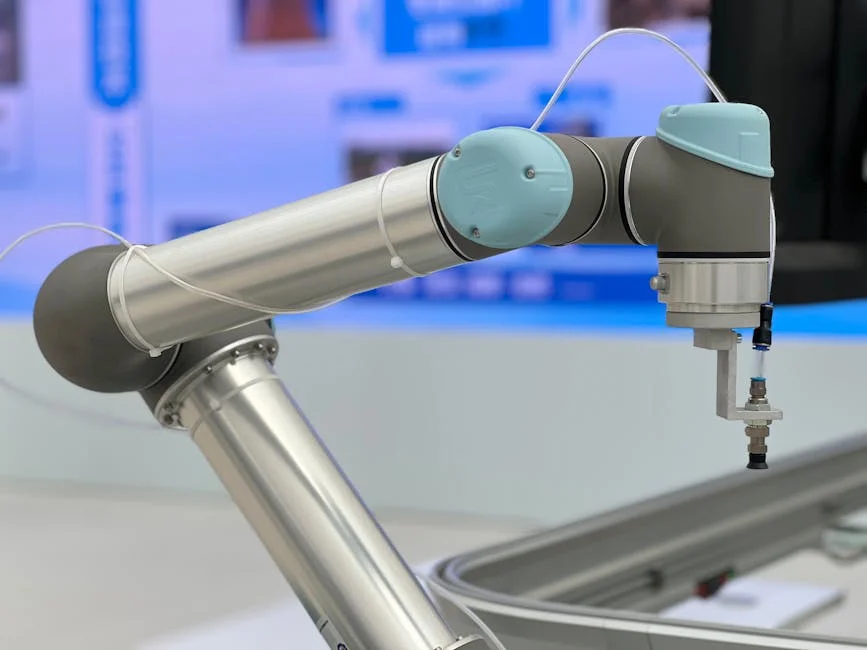
A scara robot—short for Selective Compliance Assembly Robot Arm—has become one of the most recognizable industrial robot formats for fast, accurate, and repeatable tasks on a horizontal plane. In many automated factories, the SCARA design fills a sweet spot between simple Cartesian gantries and more flexible six-axis arms. Its structure typically includes two parallel rotary joints that provide swift movement in the X-Y plane, paired with a vertical Z-axis for up-and-down motion and, in many models, a rotation about the Z-axis to orient parts. That combination makes the scara robot exceptionally well suited for pick-and-place, small-part handling, precision insertion, and high-throughput assembly where cycle time matters as much as precision. The “selective compliance” concept is central: the arm is compliant in the horizontal direction to absorb small misalignments during insertion tasks, while remaining rigid in the vertical direction to maintain accuracy and stiffness when pressing parts together.
Table of Contents
- My Personal Experience
- Understanding the SCARA Robot and Why It Matters in Modern Automation
- Core Mechanical Architecture: Selective Compliance and Kinematic Advantages
- Typical Applications: Where SCARA Robots Excel
- Performance Characteristics: Speed, Precision, Payload, and Reach
- End Effectors and Tooling: Grippers, Vacuum, Compliance, and Custom EOAT
- Control Systems and Programming: Motion Profiles, IO, and Integration
- SCARA Robot vs. Six-Axis, Delta, and Cartesian Robots: Choosing the Right Form Factor
- Designing a SCARA Workcell: Layout, Fixtures, Feeders, and Cycle Time Optimization
- Expert Insight
- Safety Considerations: Standards, Risk Assessment, and Collaborative Options
- Maintenance, Reliability, and Total Cost of Ownership
- Industries and Use Cases: Electronics, Medical Devices, Food Packaging, and More
- Future Trends: Smart SCARA Robots, Vision, AI Assistance, and Flexible Manufacturing
- How to Specify and Buy a SCARA Robot: Practical Selection Criteria
- Conclusion: Getting the Most Value from a SCARA Robot Deployment
- Watch the demonstration video
- Frequently Asked Questions
- Trusted External Sources
My Personal Experience
The first time I worked with a SCARA robot was on a small assembly line where we were placing O-rings and pressing plastic housings together. I expected it to feel like programming a full industrial arm, but the SCARA’s motion was surprisingly straightforward—fast, flat, and repeatable—once I understood its sweet spot in the horizontal plane. We had a few early hiccups with parts shifting in the tray, so I spent an afternoon tweaking the pick height, adding a short dwell before the vacuum check, and dialing in the acceleration so it wouldn’t “snap” the part loose. After that, it ran for hours without drifting, and the cycle time dropped enough that the operators stopped queuing bins at the station. What stuck with me most was how a few millimeters of calibration and a simple change in approach angle made the difference between constant babysitting and a robot you could actually trust.
Understanding the SCARA Robot and Why It Matters in Modern Automation
A scara robot—short for Selective Compliance Assembly Robot Arm—has become one of the most recognizable industrial robot formats for fast, accurate, and repeatable tasks on a horizontal plane. In many automated factories, the SCARA design fills a sweet spot between simple Cartesian gantries and more flexible six-axis arms. Its structure typically includes two parallel rotary joints that provide swift movement in the X-Y plane, paired with a vertical Z-axis for up-and-down motion and, in many models, a rotation about the Z-axis to orient parts. That combination makes the scara robot exceptionally well suited for pick-and-place, small-part handling, precision insertion, and high-throughput assembly where cycle time matters as much as precision. The “selective compliance” concept is central: the arm is compliant in the horizontal direction to absorb small misalignments during insertion tasks, while remaining rigid in the vertical direction to maintain accuracy and stiffness when pressing parts together.

From a production standpoint, the scara robot is often chosen when manufacturers want reliable speed without the complexity of a fully articulated arm. The mechanical simplicity tends to translate into lower maintenance needs, predictable performance, and easier programming for common motions. That does not mean SCARA units are simplistic; modern versions support advanced motion profiles, integrated vision guidance, force sensing, and sophisticated safety features. They are also increasingly deployed outside classic automotive or electronics assembly lines. You’ll find SCARA automation in medical device production, cosmetics packaging, lab sample handling, and food-related operations—especially where the product is small, the work surface is organized, and the process requires consistent, repeatable handling at scale. As factories pursue higher Overall Equipment Effectiveness (OEE) and tighter quality control, the scara robot continues to stand out as a purpose-built workhorse that delivers speed and precision on tasks that would otherwise require multiple operators or slower robotic alternatives.
Core Mechanical Architecture: Selective Compliance and Kinematic Advantages
The signature value of a scara robot begins with its kinematics. Most SCARA designs use a two-link planar arm with rotary joints, producing a donut-shaped work envelope that is ideal for reaching multiple stations around a central mounting location. The first joint rotates the primary arm around the base, and the second joint rotates the forearm relative to the upper arm. Together, these joints provide fast lateral motion, often with impressive acceleration and repeatability. A vertical axis—usually a ball-screw or belt-driven slide—adds the Z movement required for placing components, pressing fits, or retrieving items from trays. Many configurations add a fourth axis (rotation around Z) for part orientation. Because the structure is optimized for planar movement, inertia is typically lower than with a comparable six-axis arm, which contributes to high speed and strong settling behavior when stopping precisely at a target point.
Selective compliance is not just a marketing phrase; it’s a functional mechanical characteristic. During assembly, slight misalignments between a peg and a hole can create binding. A scara robot can be designed to offer a controlled amount of lateral compliance so the part “finds” its way into place rather than jamming. At the same time, the vertical axis remains stiff so the robot can apply consistent insertion force without deflection that would compromise depth accuracy. This is particularly valuable for press-fit operations, connector insertion, and tasks where tolerances stack across multiple components. The SCARA kinematic chain also simplifies path planning for many assembly moves: moving from one pick point to one place point often requires only coordinated motion of two rotary joints and a Z stroke. That can reduce computational complexity and help achieve very short cycle times. When paired with modern servo drives, jerk-limited motion profiles, and calibration routines, a scara robot can sustain high throughput while still meeting demanding precision requirements on repetitive tasks.
Typical Applications: Where SCARA Robots Excel
A scara robot is commonly deployed in environments that demand speed and consistent accuracy over a defined workspace. High-volume pick-and-place is one of its most common roles: transferring parts from conveyors to fixtures, from trays to nests, or from bins to inspection stations. In electronics manufacturing, SCARA automation is used for placing small components, handling printed circuit boards, loading test fixtures, and managing connectors or housings. In consumer goods and packaging, a SCARA arm can cap containers, place inserts, orient products for labeling, or load cartons with small items. Because the SCARA motion is naturally optimized for planar travel, it performs especially well when workstations are arranged around a central area and when product flow is predictable, such as in indexing dial tables or compact assembly cells.
Assembly and insertion tasks are another strong match. A scara robot can insert bearings, press bushings, seat gaskets, and mate plastic parts with consistent depth and repeatable force profiles. With the right end effector, it can handle delicate items like syringes, vials, or small molded components without excessive handling damage. Many modern SCARA systems integrate vision to compensate for part position variation, enabling “pick by camera” from randomly oriented parts in structured trays or on conveyors. In laboratory automation, SCARA units can move sample tubes, open and close caps, and load analyzers, supporting repeatable routines with minimal contamination risk when designed with appropriate materials and cleaning protocols. Manufacturers often choose SCARA when they want a compact robot that can be mounted on a bench, inside a machine enclosure, or above a work area, leaving room underneath for feeders, fixtures, and test equipment. The result is a flexible, high-speed platform that can be tailored to a wide range of light-to-medium payload tasks.
Performance Characteristics: Speed, Precision, Payload, and Reach
Evaluating a scara robot typically starts with four practical specifications: cycle time, repeatability, payload, and reach. Cycle time is a key differentiator; SCARA units are often rated using standardized motion tests that reflect typical pick-and-place patterns. Their rigid vertical axis and low moving mass allow quick acceleration and deceleration, which helps maintain throughput even when the robot must stop precisely at each point. Repeatability—often measured in hundredths of a millimeter for quality models—matters more than absolute accuracy in many production contexts, because a well-calibrated fixture and consistent part presentation can compensate for small offsets. For tasks like assembly insertion, consistent repeatability ensures parts seat correctly across thousands or millions of cycles.
Payload and reach define what the robot can physically handle and how far it can extend within the cell. A common range might be a few kilograms of payload with a reach from a few hundred millimeters up to around a meter, though there are lighter and heavier variants. It’s important to consider not only payload weight but also the moment of inertia created by the end effector and part. A long gripper holding an off-center part can stress joints and reduce achievable speed. Many scara robot datasheets provide allowable inertia values and performance curves that show how speed decreases as payload increases. Another practical performance factor is Z-axis stroke, which determines how deep the robot can reach into fixtures or packaging. If the process requires reaching into tall containers or deep nests, Z stroke can become a limiting factor. In real deployments, performance is also influenced by controller tuning, path smoothing, and how well the mechanical system is integrated with feeders, conveyors, and sensors. A SCARA arm that is theoretically fast can still be bottlenecked by slow part presentation, vision processing delays, or conservative safety settings, so the entire cell design must support the robot’s capabilities.
End Effectors and Tooling: Grippers, Vacuum, Compliance, and Custom EOAT
The effectiveness of a scara robot depends heavily on the end-of-arm tooling (EOAT). For many pick-and-place applications, vacuum cups are popular because they are lightweight, inexpensive, and fast to actuate. Vacuum tooling can handle flat packs, blister trays, small cartons, and many plastic parts, but it requires careful attention to surface texture, porosity, and cleanliness. Mechanical grippers—parallel, angular, or three-jaw—are often used for parts with defined grasp features or where vacuum is unreliable. For delicate components, soft grippers or compliant fingertips can reduce marring and improve yield. In assembly tasks, specialized tools such as insertion heads, press tools, screwdriving spindles, and dispensing valves can be mounted to the robot, turning it into a multi-purpose station that performs operations beyond simple handling.
Compliance devices are particularly relevant in SCARA automation. While the robot structure provides selective compliance in the horizontal plane, additional compliance can be added at the tool to manage tolerance variation and reduce insertion forces. Remote Center Compliance (RCC) units, floating tool mounts, and spring-loaded couplers can help align parts during peg-in-hole operations. Force/torque sensors can enable force-controlled insertion, allowing the robot to detect contact, adjust motion, and verify seating. Tool changers can add versatility, letting a scara robot pick different tools for different steps, though this adds complexity and may reduce speed. EOAT design should also consider cable routing, air lines, vacuum generators, and sensor wiring to avoid snagging and to maintain consistent motion. Lightweight tooling helps preserve acceleration and reduce wear on joints. In many cells, the best performance comes from co-designing the robot motion, the gripper, and the fixtures together. A perfectly capable SCARA arm can still struggle if the gripper is heavy, the part is unstable during transport, or the fixture does not provide adequate lead-ins for insertion. Thoughtful tooling transforms raw robot speed into stable, high-yield production.
Control Systems and Programming: Motion Profiles, IO, and Integration
Programming a scara robot is often more approachable than programming a multi-axis articulated arm for similar tasks, largely because the motion is conceptually aligned with many assembly workflows: move in X-Y, adjust Z, rotate, place, and repeat. Most SCARA controllers support point-to-point moves, linear interpolation, arc moves, and synchronized Z motion, along with acceleration and jerk settings to balance speed and vibration. For high-throughput operations, motion tuning is crucial. Small improvements in settling time or path smoothing can translate into significant productivity gains over long runs. Many controllers also support conveyor tracking, where the robot adjusts its motion based on encoder feedback from a moving belt, enabling picks on the fly without stopping product flow.

Integration goes beyond motion. Industrial IO, fieldbus protocols, and Ethernet-based networks allow the scara robot to coordinate with vision systems, PLCs, safety controllers, and upstream/downstream equipment. Typical integrations include part presence sensors, vacuum confirmation switches, barcode readers, and reject mechanisms for quality control. Vision-guided SCARA systems often rely on calibrated camera-to-robot transformations so the robot can pick parts based on pixel coordinates. When cycle time is tight, the timing of vision acquisition, processing, and robot motion must be carefully orchestrated. Programming environments vary: some vendors provide proprietary languages, while others support graphical teach pendants, offline programming, or PC-based APIs. For manufacturers managing multiple lines, standardizing on a programming approach can reduce maintenance burden and speed up changeovers. A well-integrated scara robot cell also includes robust error handling: what happens if vacuum fails, a part is missing, a fixture is not ready, or a safety gate opens. The best implementations treat robot code as part of a broader control strategy, with clear states, interlocks, and recovery routines that keep downtime low and make troubleshooting straightforward for technicians.
SCARA Robot vs. Six-Axis, Delta, and Cartesian Robots: Choosing the Right Form Factor
Choosing a scara robot is often a decision made alongside alternatives such as six-axis articulated arms, delta robots, and Cartesian systems. A six-axis arm offers the greatest flexibility in orientation and can reach around obstacles, making it ideal for complex paths, angled insertions, and tasks requiring full spatial dexterity. However, that flexibility can come with trade-offs in speed for planar pick-and-place, higher cost, and more complex programming. Delta robots excel at extremely fast picking of lightweight items, particularly in food and packaging, but their work envelope and payload can be limiting, and they typically require overhead mounting. Cartesian robots provide straightforward motion and can cover large rectangular areas, but they can be bulky and may not match SCARA’s compact footprint and agility for circular or multi-station layouts.
The scara robot stands out when the task is predominantly planar with frequent vertical moves and occasional rotation about the Z axis. Its mechanical layout often delivers faster cycle times than a six-axis arm for these patterns, while maintaining strong repeatability. It can also be easier to enclose and integrate into compact machines, supporting modular automation where the robot is essentially a component inside a larger system. That said, SCARA is not the best fit when the process requires significant wrist articulation, complex tool angles, or working around tall obstacles. If parts must be inserted at an angle, or if the robot must access multiple sides of a product, a six-axis arm may be more suitable. If the goal is ultra-high-speed sorting of very light products, a delta robot may outperform SCARA. If the workspace is long and linear, a Cartesian gantry can be more cost-effective. The most reliable selection method is to map the required motions, payload, accuracy, and station layout, then compare how each robot type meets those needs with minimal complexity. In many assembly and handling cells, the scara robot remains the pragmatic choice because it provides the right balance of speed, precision, footprint, and integration effort.
Designing a SCARA Workcell: Layout, Fixtures, Feeders, and Cycle Time Optimization
A high-performing scara robot cell starts with layout. Since the SCARA work envelope is typically circular or annular, arranging feeders, trays, fixtures, and inspection points within that envelope reduces reach extremes and helps maintain consistent speed. Keeping high-frequency pick and place points closer to the center can reduce joint travel and improve cycle time. If an indexing dial table is used, the robot can service multiple stations—loading, assembly, inspection, and unload—without moving far. For conveyor-based systems, aligning the conveyor path so that picks occur within the robot’s optimal zone can improve tracking performance and reduce the risk of singularities or awkward joint configurations. Clearance and cable management also matter; even a compact SCARA arm needs safe space for motion, and poorly routed hoses can limit speed or create maintenance issues.
| Aspect | SCARA Robot | Why it matters |
|---|---|---|
| Primary motion & axes | Selective compliance in X–Y with rigid Z; typically 4-axis (X, Y, Z, θ) | Ideal for fast planar moves while maintaining precise vertical insertion and rotation. |
| Speed & repeatability | Very high cycle speeds with strong repeatability for short, repetitive tasks | Boosts throughput in pick-and-place, assembly, and packaging lines. |
| Best-fit applications | Small-to-medium payload handling, press-fit/insertion, screwdriving, sorting | Delivers a cost-effective solution when work is mostly on a horizontal plane. |
Expert Insight
Match the SCARA robot’s strengths to the task: use it for high-speed pick-and-place, assembly, and top-down insertion where planar motion dominates. Keep payload and moment-of-inertia well below the rated limits, and place the heaviest tooling as close to the wrist as possible to maintain acceleration and repeatability.
Protect accuracy and uptime with disciplined setup: rigidly mount the base, verify Z-axis perpendicularity, and calibrate the work coordinate system to the fixture, not the conveyor. Add simple safeguards—cable management, hard stops, and routine checks for backlash and belt tension—to prevent drift and reduce unplanned downtime. If you’re looking for scara robot, this is your best choice.
Feeding and fixturing often determine whether the theoretical performance of a scara robot becomes real throughput. Vibratory bowl feeders, step feeders, and tray presentation systems must deliver parts consistently in orientation and position. If parts arrive with too much variation, the robot may need vision correction or slower approach moves to prevent collisions. Fixtures should include lead-ins, chamfers, and locating features that help parts seat reliably, especially for insertion operations. Cycle time optimization typically involves reducing dwell times, minimizing unnecessary Z travel, and using blended paths where safe. For example, lifting only as high as needed to clear obstacles can shave significant time across thousands of cycles. Similarly, using intermediate waypoints to avoid collisions can be optimized by refining station geometry rather than adding slower, more complex motion. Sensor placement can reduce waiting: a well-placed part-present sensor can allow the robot to start moving toward a pick location before the part fully settles, as long as safety and quality are not compromised. When designed holistically, a SCARA workcell can deliver stable, predictable throughput with low scrap and minimal operator intervention.
Safety Considerations: Standards, Risk Assessment, and Collaborative Options
Safety for a scara robot installation begins with a structured risk assessment. SCARA arms can move quickly, and their speed is part of their value, but it also increases the need for proper guarding, interlocks, and safe operating procedures. Typical safety measures include perimeter fencing, safety-rated door switches, light curtains, or area scanners depending on how operators interact with the cell. Emergency stop circuits, safe torque off, and safety-rated monitored stop functions are commonly integrated through the controller and external safety PLCs. Because SCARA applications often involve high-cycle pick-and-place, the robot may operate continuously, making reliable safety components and clear maintenance lockout procedures essential. The goal is to prevent access to hazardous motion while still allowing efficient loading, changeover, and troubleshooting.
Collaborative modes and power-and-force limiting concepts are more commonly associated with lightweight cobots, but some SCARA platforms and safety architectures can support reduced-speed operation or safe limited zones. Whether a SCARA can be used in a collaborative manner depends on the specific model, payload, tooling hazards, and the risk assessment outcome. Even if the robot is capable of safe limited speed, the end effector may introduce pinch points, sharp edges, or suction hazards that require guarding. Many manufacturers adopt a hybrid approach: the scara robot runs at full speed behind guarding during automatic operation, then transitions to a safe reduced-speed mode for setup or teaching with enabling devices. Good safety design also considers non-obvious risks such as dropped parts, stored pneumatic energy in grippers, and maintenance access near vertical axes. Clear signage, consistent cell status indication (stack lights), and operator training reduce the likelihood of unsafe behavior. A safe SCARA installation is not only about compliance; it’s also about uptime, because nuisance trips, unclear recovery steps, and poorly designed access points can cause frequent stops and rushed interventions that create new risks.
Maintenance, Reliability, and Total Cost of Ownership
The total cost of owning a scara robot includes far more than the purchase price. Reliability is often one of the reasons manufacturers choose SCARA: fewer axes than a six-axis arm, a mechanically straightforward structure, and well-understood motion patterns can yield long service life when properly maintained. Still, SCARA units have wear components such as belts (in some designs), bearings, seals, and lubrication points. Preventive maintenance schedules typically include inspecting cable dress packs, checking fasteners, monitoring backlash or repeatability drift, and maintaining the end effector. If the robot operates in dusty environments, abrasive particles can accelerate wear, and additional protective measures like bellows, covers, or positive-pressure enclosures may be warranted. In washdown or cleanroom contexts, material selection and sealing become critical to prevent contamination and corrosion.
Downtime costs can dwarf hardware costs, so maintainability should be designed into the cell. Quick-change grippers, accessible air regulators, labeled wiring, and standardized spare parts reduce mean time to repair. Controller backups, version control for robot programs, and documented recovery procedures help technicians restore production quickly after faults. Monitoring solutions can also improve reliability: tracking motor currents, cycle counts, vacuum performance, and error codes can reveal early signs of issues such as a failing gripper seal or increasing friction on an axis. Another cost factor is changeover time. If the product mix changes frequently, investing in flexible fixtures, vision guidance, and parameterized programs can reduce the labor required to retool the cell. When budgeting, it is also important to account for integration engineering, safety hardware, tooling design, and validation testing. A scara robot may be competitively priced, but the best ROI comes from a stable, maintainable system that runs at target cycle time with minimal operator intervention and predictable quality output.
Industries and Use Cases: Electronics, Medical Devices, Food Packaging, and More
Electronics manufacturing has long been a natural environment for a scara robot because components are small, tolerances are tight, and throughput demands are high. SCARA arms handle tasks such as placing components into housings, loading and unloading test fixtures, managing connectors, and transferring parts between stations on compact assembly lines. With integrated vision, they can pick parts from trays with minor positional variation and place them accurately into nests. The repeatability and speed of SCARA motion support consistent assembly quality, which is essential when defects can be difficult to detect later in the process. The compact footprint also helps in electronics plants where multiple lines must fit into limited floor space, and where equipment is often arranged in dense, modular cells.

Medical device production and laboratory automation also benefit from SCARA characteristics, particularly when processes require careful, repeatable handling. A scara robot can assemble small subcomponents, load sterilization trays, or move sample containers with minimal human contact. In regulated environments, traceability and process validation are important, and robot automation can support consistent execution and electronic logging. In food and consumer goods packaging, SCARA systems are often used for secondary packaging tasks such as placing items into cartons, orienting products for labeling, or assembling promotional kits. While primary food contact applications may favor delta robots or specialized hygienic designs, SCARA can still play a major role in end-of-line or semi-enclosed packaging operations. Other industries include automotive subassembly (small parts, clips, sensors), cosmetics (small containers and caps), and general manufacturing where light payloads and repetitive handling dominate. The common thread is a structured workspace and a need for fast, reliable movement in a horizontal plane—conditions where a scara robot consistently delivers strong performance.
Future Trends: Smart SCARA Robots, Vision, AI Assistance, and Flexible Manufacturing
The scara robot continues to evolve as factories demand more flexible automation. One major trend is deeper integration of vision systems and smarter sensing. Where SCARA cells once relied heavily on precise part presentation, modern solutions increasingly use cameras to locate parts, verify orientation, and confirm presence before placement. This reduces the burden on feeders and fixtures and supports faster changeovers when product variants change. Another trend is improved servo control and motion optimization, including advanced vibration suppression and adaptive tuning. These features help maintain high speed without sacrificing precision, especially as tooling becomes more complex and as manufacturers push shorter cycle times. Connectivity is also expanding: SCARA controllers are more frequently integrated into plant-wide networks for production monitoring, predictive maintenance, and centralized recipe management.
AI assistance is emerging more as a support layer than as a replacement for deterministic robot control. For example, machine learning can improve vision classification, detect anomalies in motion or vacuum signals, and suggest maintenance interventions based on patterns across many cycles. Digital twins and offline simulation tools make it easier to validate a scara robot cell before physical build, reducing commissioning time and avoiding costly layout mistakes. Flexible manufacturing is another driver. As product lifecycles shrink, the ability to reconfigure a cell becomes as important as its raw speed. Modular tooling, quick-change fixtures, and parameter-driven programs allow SCARA automation to adapt to new SKUs with less downtime. Even with these changes, the core appeal remains the same: a scara robot provides a disciplined, high-speed motion platform that fits well into compact assembly and handling stations. As factories seek higher responsiveness, better data visibility, and consistent quality, SCARA technology is likely to remain a foundational element in many automated lines rather than a niche solution.
How to Specify and Buy a SCARA Robot: Practical Selection Criteria
Selecting a scara robot starts with a clear definition of the task and the real production constraints. Payload is not just the part weight; it includes the gripper, fittings, sensors, and the dynamic loads created by acceleration. Reach should cover all pick and place points with margin, but oversizing reach can reduce stiffness and increase cost, so a measured approach is best. Repeatability requirements should be tied to the process capability target: a press-fit insertion may need tighter repeatability than a simple transfer into a wide pocket. Z stroke, allowable inertia, and available mounting options (floor, wall, ceiling) can quickly narrow the field. If the process uses vision guidance, compatibility with camera systems, calibration workflows, and communication protocols should be considered early. If the robot must operate in special environments—ESD-safe electronics areas, cleanrooms, or washdown packaging—material and sealing options matter as much as motion performance.
Controller features can be decisive. Look for the IO capacity and expansion options needed for sensors and actuators, the fieldbus protocols required by the plant, and safety features that align with the risk assessment. Consider the programming environment and the skill level of the maintenance team; a scara robot that is easy to troubleshoot and restore can outperform a more advanced system that only specialists can maintain. Service and support availability is another practical factor: lead times for spare parts, local integrator expertise, and vendor training resources influence long-term uptime. Finally, validate performance with realistic cycle time studies rather than relying solely on catalog numbers. A vendor demo that includes your part, your gripper concept, and your station layout can reveal hidden constraints like part stability during acceleration or vacuum reliability. With a careful specification process, a scara robot can be purchased and deployed as a predictable production asset rather than an experiment, delivering speed and consistency while fitting neatly into existing manufacturing workflows.
Conclusion: Getting the Most Value from a SCARA Robot Deployment
Maximizing value from a scara robot comes down to aligning the robot’s strengths—fast planar motion, high repeatability, compact integration, and selective compliance—with a process designed to take advantage of those strengths. When the station layout supports efficient reach, when part presentation is consistent or vision-guided appropriately, and when tooling is lightweight and reliable, SCARA automation can deliver excellent throughput with stable quality. The best results also come from disciplined integration: robust safety, clear interlocks, thoughtful error recovery, and maintenance-friendly design that keeps downtime low. A scara robot is not a universal solution for every motion challenge, but within its ideal domain it remains one of the most effective and economical ways to automate high-speed assembly and handling, and the right implementation can make a scara robot a long-term cornerstone of efficient production.
Watch the demonstration video
In this video, you’ll learn what a SCARA robot is and why it’s widely used in fast, precise assembly and pick-and-place tasks. It explains SCARA’s unique arm structure, how its joints move for quick horizontal motion with vertical compliance, and the key advantages and limitations to consider when choosing it for automation.
Summary
In summary, “scara robot” is a crucial topic that deserves thoughtful consideration. We hope this article has provided you with a comprehensive understanding to help you make better decisions.
Frequently Asked Questions
What is a SCARA robot?
A **scara robot** (Selective Compliance Assembly Robot Arm) is a four-axis industrial robot built for speed and accuracy, making it ideal for high-throughput pick-and-place tasks and precise assembly work across a horizontal plane.
What are SCARA robots commonly used for?
They’re widely used for high-speed pick-and-place, small-part assembly, screwdriving, packaging, and electronics/medical device handling.
How does a SCARA robot differ from a 6-axis robot?
SCARAs excel at rapid planar motion with simpler kinematics, while 6-axis robots provide full orientation control for complex 3D paths and angles.
What does “selective compliance” mean in SCARA robots?
The arm is designed to be compliant—more flexible—across the horizontal X‑Y plane to make insertion tasks smoother, while remaining rigid along the vertical Z axis for precise, repeatable up‑and‑down positioning, which is a key advantage of a **scara robot**.
What are typical SCARA robot specifications to consider?
Key specs include payload, reach, repeatability, cycle time, Z-stroke, mounting orientation, and controller/I-O or fieldbus support.
What are the main advantages and limitations of SCARA robots?
A **scara robot** is a popular choice for assembly tasks because it delivers very fast cycle times, excellent repeatability, a compact footprint, and strong cost efficiency. That said, it typically offers fewer orientation axes than more complex robots, which makes it less ideal for applications that require intricate 3D manipulation.
? Looking for more info about scara robot? Follow Our Site for updates and tips!

Trusted External Sources
- SCARA Robots | FANUC America
FANUC’s SCARA Robots are a powerful pick-and-place robot solution for manufacturing operations that require increased speed and repeatability.
- SCARA – Wikipedia
A **scara robot** is a widely used type of industrial robot designed for fast, precise assembly tasks. The name SCARA stands for *Selective Compliance Assembly Robot Arm* (sometimes also *Selective Compliance Articulated Robot Arm*), reflecting its ability to stay rigid in some directions while remaining flexible in others for efficient movement.
- KR SCARA Robot- ideal for assembly, joining tasks, pick&place
This lightweight, slim robot arm combines exceptional speed with impressive strength—delivering peak performance for demanding applications in electromobility, electronics, biomedicine, and more. As a high-precision **scara robot**, it’s built to handle fast, reliable pick-and-place and assembly tasks where accuracy and throughput matter most.
- What Is a SCARA Robot? The Background and Benefits – RoboDK
Mar 3, 2026 … SCARA robots are one of the most popular and easy-to-use industrial robotic arms. They are commonly used in a variety of industries, often for manufacturing …
- SCARA Robot IXA, IXP & IX Series – IAI America
IX SCARA robots are built for fast, high-precision automation—making them a strong choice for tasks like sealing, dispensing, parts insertion, and assembly. With the speed and repeatability you expect from a **scara robot**, they help streamline production while maintaining consistent, accurate results.