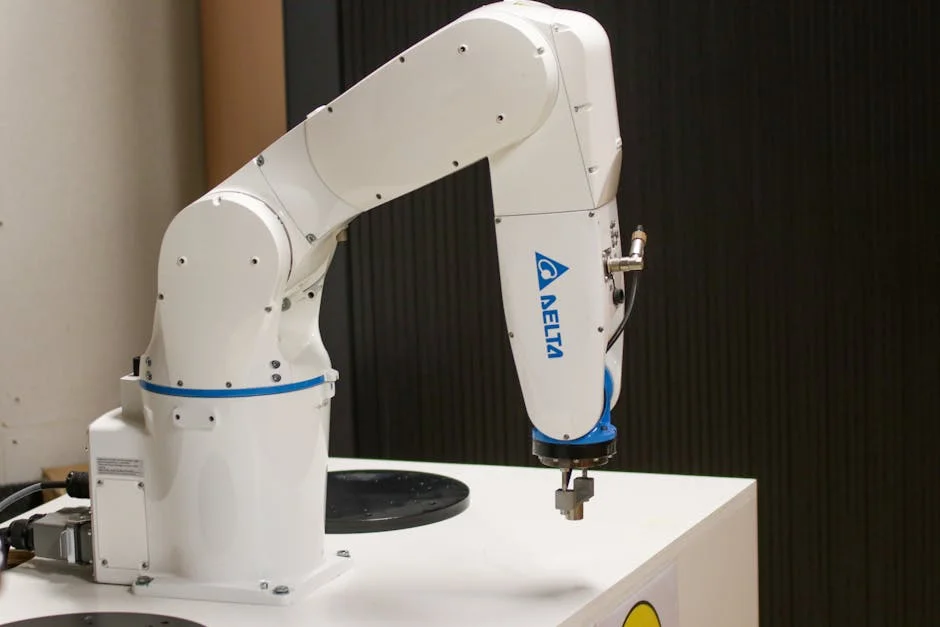
A scara robot has become one of the most recognizable automation tools on factory floors because it solves a very specific problem extremely well: fast, repeatable motion in a horizontal plane with controlled vertical movement. The name comes from “Selective Compliance Assembly Robot Arm,” which hints at the design principle that makes this machine so useful. A SCARA arm is typically compliant (flexible) in the X-Y plane while remaining rigid in the Z axis, allowing it to absorb small alignment errors during insertion or assembly while maintaining accurate vertical placement. That combination enables high-speed pick-and-place, screwdriving, press-fitting, dispensing, and light assembly tasks where throughput and precision are both important. Manufacturers often choose a scara robot when they need a compact footprint, short cycle times, and reliable repeatability without the complexity or cost that can accompany other robot architectures.
Table of Contents
- My Personal Experience
- Understanding the SCARA Robot and Why It Matters in Modern Automation
- How a SCARA Robot Is Built: Kinematics, Axes, and Mechanical Structure
- Key Performance Characteristics: Speed, Repeatability, Payload, and Reach
- Common Applications: Assembly, Pick-and-Place, Packaging, and Material Handling
- SCARA Robot vs. 6-Axis Robot vs. Cartesian: Choosing the Right Architecture
- Tooling and End Effectors for SCARA Automation: Grippers, Vacuum, and Process Tools
- Controls, Programming, and Motion Profiles: Getting the Most from a SCARA Robot
- Integration in Production Lines: Layout, Feeding, Conveyors, and Cell Design
- Expert Insight
- Safety, Standards, and Risk Reduction in SCARA Robot Deployments
- Maintenance, Reliability, and Total Cost of Ownership for SCARA Automation
- Industries and Use Cases Where a SCARA Robot Excels: Electronics, Medical, and Beyond
- Future Trends: Vision, AI, Digital Twins, and Smarter SCARA Robot Cells
- Practical Buying Considerations: Specifications, Vendors, and Validation Testing
- Conclusion: When a SCARA Robot Is the Right Fit for High-Speed, High-Quality Production
- Watch the demonstration video
- Frequently Asked Questions
- Trusted External Sources
My Personal Experience
The first time I worked with a SCARA robot was on a small assembly line where we were placing tiny plastic caps onto filled vials. I expected it to feel intimidating, but once we dialed in the pick points and taught a few waypoints, it became oddly satisfying to watch—fast, repeatable, and precise in that flat, sweeping motion SCARAs do so well. The biggest lesson for me was how much the “simple” stuff matters: a slightly misaligned fixture or a worn suction cup would cause intermittent misses that looked like software problems at first. After a couple of late shifts tweaking the end effector and adding a quick sensor check, the cycle time dropped and the jams basically disappeared. It made me appreciate how a SCARA isn’t just a robot arm—it’s a whole system that only performs as well as the details around it.
Understanding the SCARA Robot and Why It Matters in Modern Automation
A scara robot has become one of the most recognizable automation tools on factory floors because it solves a very specific problem extremely well: fast, repeatable motion in a horizontal plane with controlled vertical movement. The name comes from “Selective Compliance Assembly Robot Arm,” which hints at the design principle that makes this machine so useful. A SCARA arm is typically compliant (flexible) in the X-Y plane while remaining rigid in the Z axis, allowing it to absorb small alignment errors during insertion or assembly while maintaining accurate vertical placement. That combination enables high-speed pick-and-place, screwdriving, press-fitting, dispensing, and light assembly tasks where throughput and precision are both important. Manufacturers often choose a scara robot when they need a compact footprint, short cycle times, and reliable repeatability without the complexity or cost that can accompany other robot architectures.

At a practical level, the appeal of a scara robot is that it matches common industrial motions: reach to a point, move laterally to another point, and perform a quick up-down action. This is why SCARA automation is common in electronics, consumer goods, medical device assembly, and packaging lines. The typical configuration includes two rotary joints for planar motion, a vertical linear axis (or a short stroke Z slide), and a wrist rotation axis for orienting the end effector. With that layout, the robot can “swing” quickly between stations, perform precise placements, and repeat the same trajectory thousands of times per hour. Compared with Cartesian gantries, a SCARA arm often achieves higher speed with less moving mass. Compared with many 6-axis articulated robots, it can be easier to program for 2D/2.5D tasks and may deliver better cycle time for short, repetitive moves. These characteristics explain why SCARA systems remain a core building block in automation strategies focused on efficiency, quality, and scalable production.
How a SCARA Robot Is Built: Kinematics, Axes, and Mechanical Structure
The mechanical structure of a scara robot is designed around planar kinematics. Most models use two rotational joints (often called J1 and J2) to create motion in the X-Y plane. These joints form a two-link arm, similar to a human shoulder and elbow, but optimized for industrial stiffness, low backlash, and high acceleration. The end of the second link typically carries a Z-axis slide that moves vertically for approach and retract actions. Many SCARA designs add a fourth axis, a rotation around the vertical axis (often called R or J4), which allows the end effector to rotate to align parts, orient labels, or twist a component into place. This 4-axis configuration is common because it balances simplicity with the flexibility required in real assembly cells. Some variants add a fifth axis or specialized compliance mechanisms, but the classic SCARA layout remains dominant for high-speed assembly.
Key mechanical choices influence performance: arm length (reach), gear train type, motor sizing, and structural rigidity. A scara robot often uses harmonic drives, cycloidal reducers, or precision belt drives to reduce backlash and maintain repeatability. The Z axis may be driven by a ballscrew, belt, or linear motor depending on speed and load requirements. The wrist rotation axis can be direct-driven or geared, and that decision affects both accuracy and maintenance. The base is usually rigid and compact, allowing the robot to be mounted on a workbench, a machine frame, or a pedestal. Because SCARA motion is concentrated in the horizontal plane, the base sees significant torsional loads during rapid acceleration and deceleration; high-quality cast or machined housings help manage these forces. Understanding these structural elements helps explain why a scara robot can deliver impressive cycle times: the arm is optimized to move quickly where it matters most, with the Z axis handling short, controlled vertical moves rather than long, heavy vertical travel.
Key Performance Characteristics: Speed, Repeatability, Payload, and Reach
When evaluating a scara robot, performance is usually described by reach, payload, repeatability, and cycle time. Reach is typically measured from the center of the base to the furthest point the tool flange can reach in the horizontal plane. Common reaches include 350 mm, 450 mm, 550 mm, 650 mm, and 800+ mm, though the market includes both compact and long-reach options. Payload often ranges from 1 kg to 20 kg, with many popular models sitting in the 3–10 kg range. Repeatability is frequently in the ±0.01 mm to ±0.03 mm range, depending on model and load, which is a key reason SCARA automation is favored for precision placement and insertion tasks. A scara robot can maintain this repeatability at high speeds because the kinematic chain is relatively short and stiff compared with longer articulated arms.
Cycle time is where the SCARA arm often shines. Manufacturers commonly cite a standard “pick-and-place” cycle such as 25/300/25 mm (vertical/horizontal/vertical) measured under defined conditions. SCARA cycle times can be exceptionally fast, especially for small payloads and short moves, because the arm is light relative to its payload capacity and the motors are tuned for high acceleration. However, real-world performance depends on end effector mass, cabling, gripper actuation time, vision processing latency, and the motion profile chosen in the controller. It is also important to consider the usable work envelope: a scara robot has a donut-shaped horizontal workspace, and there can be a “dead zone” near the base where the arm cannot reach due to joint limits. For process design, it’s not enough to know the maximum reach; the placement of feeders, conveyors, fixtures, and inspection points must align with the robot’s best-performing region, typically where joint angles avoid extreme extension and where inertia is balanced.
Common Applications: Assembly, Pick-and-Place, Packaging, and Material Handling
A scara robot is widely used for pick-and-place operations because its planar motion is naturally suited to moving parts between trays, conveyors, bowls, and fixtures. In electronics manufacturing, SCARA automation frequently handles components, housings, connectors, and small assemblies that require consistent placement. The robot can pick parts from a feeder, orient them with a wrist rotation, and place them into a fixture with controlled Z-axis insertion. In consumer goods and packaging, a SCARA arm can load products into cartons, place promotional inserts, or transfer items between stations where the process is mostly in a horizontal plane. Because the robot can be mounted above a work area, it also helps keep the footprint small and leaves space for tooling underneath.
Assembly tasks are another strong fit, particularly when selective compliance helps compensate for minor misalignment. Press-fitting bearings, inserting pins, placing O-rings, snapping plastic features, applying adhesive beads, and driving screws are all common SCARA use cases. The robot’s Z-axis rigidity supports consistent insertion forces, while its planar compliance can reduce the risk of jamming during alignment-sensitive operations. In addition, a scara robot can perform light material handling such as transferring parts to test stations, moving items through a small curing area, or loading and unloading small CNC fixtures where the part orientation is relatively consistent. Many cells combine SCARA motion with vision guidance for random part picking or for locating parts on a moving conveyor. While high-speed delta robots are also popular for packaging, SCARA automation often wins when tasks require more vertical stroke, more payload, higher insertion stiffness, or a more compact integration with fixtures and machine tools.
SCARA Robot vs. 6-Axis Robot vs. Cartesian: Choosing the Right Architecture
Choosing between a scara robot, a 6-axis articulated robot, and a Cartesian gantry is mainly about matching the robot’s strengths to the task. A SCARA arm excels at fast, repetitive moves in a plane with short Z motion, making it ideal for assembly cells, dispensing patterns, and indexing between stations. A 6-axis robot offers far more orientation freedom, which is critical for complex paths, angled insertions, reaching around obstacles, and tasks that require tool tilt, such as welding, complex gluing, and multi-angle machine tending. Cartesian systems provide straightforward linear motion and can be very rigid and accurate, especially over long distances. They can also be cost-effective when the workspace is rectangular and large. However, Cartesian systems can be bulky, and their moving mass can limit cycle time unless carefully engineered.

From a programming perspective, SCARA automation is often simpler than 6-axis motion for 2D/2.5D tasks because the kinematics are less complex and the tool orientation is usually limited to rotation around the vertical axis. That can translate to shorter commissioning time and fewer surprises in path planning. From a mechanical perspective, a scara robot can be more compact than a Cartesian setup and can be easier to mount above a work area. On the other hand, if the process requires significant reach into deep machines, large vertical travel, or frequent changes in tool angle, a 6-axis robot may be the better long-term solution despite potentially slower cycle time for short moves. A practical selection method is to map required points, orientations, and approach vectors, then compare cycle time, footprint, tooling complexity, and future flexibility. In many factories, the most efficient automation strategy uses SCARA arms for high-speed assembly stations and 6-axis robots for flexible handling and machine tending, with Cartesian systems reserved for large-area transfer or precision linear processes.
Tooling and End Effectors for SCARA Automation: Grippers, Vacuum, and Process Tools
The effectiveness of a scara robot depends heavily on the end effector. For pick-and-place, vacuum cups are common because they are lightweight, fast, and simple. A properly designed vacuum gripper can handle a wide range of part sizes and materials, but it requires attention to surface finish, porosity, and contamination. Mechanical grippers are preferred when parts are heavy, oily, perforated, or require secure retention during fast acceleration. Parallel pneumatic grippers are popular for their speed and cost, while servo-electric grippers provide adjustable force control and position feedback, which can be useful for delicate components and quality monitoring. In SCARA automation, minimizing tooling mass is crucial because it directly affects cycle time, motor load, and long-term wear.
For process applications, SCARA tooling can include screwdrivers, nut runners, dispensers for adhesives or sealants, soldering tools, and small press units. A scara robot can also carry compliance devices, such as remote center compliance (RCC) modules, to improve insertion success in tight-tolerance assemblies. Cable management and hose routing matter more than many teams expect: poor routing can introduce drag, reduce repeatability, or cause premature wear. Tool changers are less common on SCARA arms than on 6-axis robots, but they are used when a cell must handle multiple part types or processes. Sensors are often integrated into the end effector, including part-present sensors, vacuum pressure switches, force sensors, and small cameras for close-up inspection. The best SCARA automation designs treat the robot and end effector as a single system, optimizing the tool for stiffness, low inertia, and maintainability while ensuring the gripper or process tool can tolerate the robot’s acceleration and the factory’s operating environment.
Controls, Programming, and Motion Profiles: Getting the Most from a SCARA Robot
Programming a scara robot typically involves teaching points, defining coordinate frames, and selecting motion types that balance speed with smoothness. Most controllers support joint moves for fast repositioning and linear moves for controlled approach, insertion, or dispensing. Because SCARA tasks are often repetitive and time-sensitive, motion tuning is important. Acceleration limits, jerk settings, and cornering behavior can dramatically affect cycle time and part stability. A well-tuned SCARA arm can reduce settling time at each point, which is critical for high-throughput lines. Many controllers also provide built-in palletizing functions, conveyor tracking, and I/O handling that simplify integration with feeders and sensors. For more advanced applications, offline programming can help validate reach, avoid joint limits, and estimate cycle time before the cell is built.
Vision integration is increasingly common in SCARA automation. A camera can locate parts with positional variation, correct for conveyor drift, or verify orientation before placement. In these systems, calibration between the camera frame and the robot frame is essential. Small errors in calibration can translate into misplacements at high speed, especially when the robot operates near the edge of its workspace. Another key control concept is compliance and force management. While many SCARA arms are position-controlled, some applications benefit from force sensing or “soft” insertion routines that detect contact and reduce force to prevent damage. Even without full force control, careful programming can improve robustness: using search patterns, staged approach heights, and controlled insertion speeds can reduce jams. A scara robot is often selected for its speed, but the best outcomes come from balancing speed with process capability, ensuring the robot’s motion profile supports consistent assembly quality rather than simply minimizing cycle time.
Integration in Production Lines: Layout, Feeding, Conveyors, and Cell Design
Successful SCARA automation depends on cell layout as much as robot selection. Because a scara robot’s strength is fast planar motion, it performs best when feeders, fixtures, and output points are arranged to minimize long reaches and awkward joint configurations. Common layouts position a parts feeder on one side, a work fixture in front, and an outfeed conveyor on the other side, allowing short arcs between stations. Mounting height matters: too low and the robot may collide with fixtures; too high and the Z stroke may be insufficient for deep insertions, or the arm may lose stiffness due to longer tool extensions. Designers also need to consider maintenance access, guarding, and the routing of air lines and cables. A compact SCARA cell can deliver excellent throughput, but only if operators can safely clear jams and replenish consumables without disrupting the robot’s geometry or calibration.
| Aspect | SCARA Robot | 6‑Axis Articulated Robot | Cartesian (Gantry) Robot |
|---|---|---|---|
| Best fit applications | High-speed pick-and-place, assembly, packaging, dispensing; strong in planar (X‑Y) work | Complex tasks needing full orientation control: welding, machine tending, inspection, multi-angle assembly | Large work envelopes, straight-line moves: palletizing, CNC loading, 3D printing, material handling |
| Motion & workspace | 2 rotary joints for fast X‑Y motion + vertical Z; selective compliance aids insertion; limited reach around obstacles | Six rotary joints; highly flexible, can reach around fixtures; more complex path planning | Linear axes (X/Y/Z); box-shaped workspace; straightforward kinematics but less dexterous around obstructions |
| Speed, precision & cost | Very fast cycle times with good repeatability; typically lower cost than 6‑axis for similar payloads | Generally slower than SCARA for short cycles; higher cost/complexity but maximum versatility | High precision and stiffness; cost scales with size; fast on long straight moves but less efficient for tight cycles |
Expert Insight
When specifying a SCARA robot, match the arm reach and payload to the heaviest part plus tooling, then verify cycle time with real acceleration limits—not just top speed. Add a small safety margin for future product variants, and confirm the required repeatability at the actual working radius where the robot will spend most of its time.
Improve uptime by designing the end-of-arm tooling for quick changeover and by routing cables and air lines to avoid tight bends through the robot’s full range of motion. During commissioning, tune pick-and-place paths with smooth approach and retract moves, and use consistent part presentation (fixtures, stops, or vision) to reduce corrective motions and boost throughput. If you’re looking for scara robot, this is your best choice.
Part feeding is often the hidden challenge. Bowl feeders, tray feeders, tape-and-reel, and flexible feeders each introduce different variability in part presentation. A scara robot can compensate for some variability with vision guidance, but consistent part orientation and stable pickup points still matter for speed and reliability. Conveyors add complexity when parts are moving; conveyor tracking requires accurate encoder feedback and low-latency communication between the conveyor system and the robot controller. In mixed-model production, quick-change fixtures and recipe management become important so the SCARA arm can switch between products with minimal downtime. Cell designers also increasingly incorporate in-line inspection, such as presence checks, barcode reading, or dimensional verification. Integrating inspection with SCARA automation can reduce rework and improve traceability, but it requires thoughtful timing so inspection does not become the bottleneck. When the cell is designed around the robot’s natural motion and the process requirements are clearly defined, a scara robot can serve as a high-speed backbone that connects feeding, assembly, inspection, and packaging into a cohesive workflow.
Safety, Standards, and Risk Reduction in SCARA Robot Deployments
Any scara robot installation must address safety from the earliest design stage. SCARA arms move quickly, and even small payloads can create significant impact forces at high speed. Common safety measures include perimeter guarding, interlocked doors, safety-rated light curtains, area scanners, and emergency stop circuits. The exact approach depends on the risk assessment, which evaluates hazards such as crushing, pinching, entanglement, and unexpected restart. Many SCARA applications involve sharp tools (screwdrivers, blades), hot processes (soldering), or chemicals (adhesives), which add process-specific hazards. Safety design should also consider the end effector: a vacuum gripper dropping a part can create secondary hazards, while a mechanical gripper can pinch during manual intervention if not properly safeguarded.

Relevant standards vary by region, but common frameworks include ISO 10218 for industrial robot safety and ISO 13849 or IEC 62061 for safety-related control systems. Even when collaborative operation is desired, most SCARA arms are used in traditional industrial settings with physical guarding, because their speed and motion profile are not typically optimized for close human interaction. Some vendors offer power-and-force-limited features or safe speed monitoring, but the feasibility depends on payload, tooling, and required throughput. A practical safety strategy for SCARA automation includes: limiting access during automatic mode, providing a safe manual mode with reduced speed, implementing safety-rated stop and safe torque off, and ensuring clear procedures for clearing jams and performing maintenance. Good safety design also improves productivity: when operators can replenish parts and clear issues quickly through well-defined safe zones and interlocks, the cell spends more time producing and less time waiting on troubleshooting or unsafe workarounds. If you’re looking for scara robot, this is your best choice.
Maintenance, Reliability, and Total Cost of Ownership for SCARA Automation
A scara robot is often chosen for high duty-cycle environments, so maintenance planning should be part of the initial cost evaluation. Routine tasks typically include checking and replacing grease in reducers, inspecting belts or couplings, verifying fasteners, and ensuring cable carriers and hoses are not worn or snagging. End effectors often require more frequent attention than the robot itself: vacuum filters clog, cups wear, pneumatic seals degrade, and gripper fingers can loosen or chip. Preventive maintenance schedules should reflect the actual cycle count, payload, and environment. Dusty environments can accelerate wear, while cleanroom or ESD-sensitive environments may require specialized materials and procedures. Monitoring temperature, vibration, and motor load can help detect issues early, especially in high-speed applications where small mechanical problems can quickly affect accuracy.
Total cost of ownership (TCO) includes far more than the purchase price of the SCARA arm. Integration costs—tooling, feeders, guarding, vision, conveyors, and engineering time—often exceed the robot cost. Downtime costs can be even more significant, so reliability and service support matter. When comparing SCARA automation options, consider spare parts availability, mean time to repair, ease of replacing cables or motors, and the vendor’s local service network. Software and controller features also affect TCO: a controller that simplifies recipe management, diagnostics, and remote support can reduce downtime and speed up changeovers. Energy usage is usually modest for a scara robot, but compressed air usage for pneumatic grippers and vacuum generation can be substantial; optimizing air consumption can reduce operating costs. A robust TCO approach balances speed and performance against maintainability and process stability, ensuring the cell can run consistently over years rather than only meeting initial cycle-time targets.
Industries and Use Cases Where a SCARA Robot Excels: Electronics, Medical, and Beyond
Electronics manufacturing remains one of the strongest domains for a scara robot because so many tasks involve small parts, high precision, and high throughput. Placing connectors, assembling housings, applying adhesives, and transferring boards between stations are all common. SCARA automation also pairs well with ESD controls, such as grounded tooling and specialized materials, which are essential for protecting sensitive components. In battery manufacturing and energy storage, SCARA arms can handle small modules, apply sealants, and support test operations where consistent placement is critical. The combination of repeatability and speed helps maintain quality while meeting production targets, especially when multiple SCARA cells operate in parallel for scalable capacity.
Medical device production is another area where SCARA automation is frequently used, particularly for sterile or clean manufacturing environments. Tasks such as assembling syringe components, placing caps, handling diagnostic cartridges, or dispensing controlled volumes can benefit from the precise Z-axis control and repeatable planar motion of a scara robot. In these environments, validation, traceability, and process consistency are just as important as cycle time. Food and beverage applications may use SCARA systems for secondary packaging or handling sealed items, although washdown requirements can limit options unless the robot is designed for that environment. In automotive and industrial component assembly, SCARA arms are used for sub-assemblies, small part placement, and feeding operations that support larger robotic cells. Across these industries, the common thread is a process that rewards fast, repeatable motion with controlled vertical insertion. When the application matches that profile, a scara robot can deliver a strong balance of productivity, quality, and integration simplicity.
Future Trends: Vision, AI, Digital Twins, and Smarter SCARA Robot Cells
The future of the scara robot is closely tied to smarter perception and more adaptive control. Vision systems are becoming faster and easier to deploy, with improved calibration tools and better robustness to lighting changes. This allows SCARA automation to move beyond fixed, highly structured feeding and into more flexible workflows where parts arrive with variation. While SCARA arms are not typically used for complex 3D manipulation, they benefit greatly from 2D vision and depth-assisted checks that improve pick reliability and placement verification. Another trend is the increased use of integrated force sensing or torque estimation, enabling gentler insertions and better detection of misalignment during assembly. These capabilities reduce scrap and improve process stability, especially for delicate parts and tight-tolerance fits.

Digital twins and simulation are also reshaping how SCARA cells are designed and maintained. By modeling the scara robot, tooling, fixtures, and cycle logic, engineers can validate reach, collision clearance, and throughput before hardware arrives. This reduces commissioning time and helps teams explore alternatives, such as different feeder positions or motion profiles, without expensive physical rework. Connectivity is improving as well: modern controllers can publish production data, alarms, and performance metrics to factory systems for predictive maintenance and continuous improvement. As manufacturers push for more flexible, high-mix production, SCARA automation will increasingly rely on quick-change tooling, recipe-driven programming, and guided setup procedures that reduce dependence on specialized programming skills. Even with these advances, the core appeal remains the same: a scara robot provides fast, accurate planar motion with reliable vertical placement, and smarter peripherals make that capability more adaptable to real-world variability.
Practical Buying Considerations: Specifications, Vendors, and Validation Testing
Selecting a scara robot for a production environment requires translating process needs into measurable specifications. Start with the part: weight, center of gravity, fragility, and required orientation. Then define the required workspace: pickup and placement coordinates, approach heights, and any obstacles. From there, determine reach, payload, and Z stroke requirements with margin for tooling mass and future changes. Repeatability should be aligned with the process tolerance, but also consider the overall system stack-up: fixture accuracy, part variability, and vision calibration can dominate error more than the robot’s nominal repeatability. Pay attention to controller capabilities, I/O, fieldbus support (such as EtherNet/IP, PROFINET, or EtherCAT), and how easily the robot integrates with existing PLC standards. For SCARA automation, cycle time claims should be validated against your actual motion path, not just a marketing benchmark.
Vendor evaluation should include service support, spare parts lead times, documentation quality, and training resources. A scara robot may run for years, and fast recovery from faults can be as valuable as raw speed. Validation testing is essential: perform payload tests, repeatability checks under realistic acceleration, and process trials with real parts and tooling. If the application involves dispensing, verify bead consistency at production speed. If it involves insertion, test robustness across part tolerances and temperature variation. Also test recovery procedures: how quickly can the cell restart after a jam, and does the robot return to a known-safe state? These practical checks reduce the risk of costly surprises after installation. When chosen with a clear understanding of process needs, a scara robot can be a highly dependable foundation for automation that scales with demand and maintains consistent quality over long production runs.
Conclusion: When a SCARA Robot Is the Right Fit for High-Speed, High-Quality Production
A scara robot is most valuable when the process demands fast, repeatable horizontal motion combined with controlled vertical placement, especially in assembly and pick-and-place environments where consistency directly affects yield. The selective compliance that defines the SCARA arm helps it tolerate small misalignments during insertion, while its compact structure supports high acceleration and short cycle times. Real success with SCARA automation comes from treating the robot as part of a complete system: cell layout, part presentation, end effector design, safety strategy, and controller tuning all influence throughput and quality as much as the robot’s datasheet. With careful selection and validation, a scara robot can provide a durable, efficient automation platform that meets production targets today while remaining adaptable to new product variants and evolving factory requirements.
Watch the demonstration video
In this video, you’ll learn what a SCARA robot is and why it’s widely used in fast, precise automation. It explains the robot’s unique arm structure, how its selective compliance improves speed and accuracy, and where it excels—such as pick-and-place, assembly, and packaging tasks in modern manufacturing.
Summary
In summary, “scara robot” is a crucial topic that deserves thoughtful consideration. We hope this article has provided you with a comprehensive understanding to help you make better decisions.
Frequently Asked Questions
What is a SCARA robot?
A SCARA (Selective Compliance Assembly Robot Arm) is a 4-axis industrial robot optimized for fast, precise pick-and-place and assembly, with compliance in the horizontal plane and rigidity in the vertical axis. If you’re looking for scara robot, this is your best choice.
What applications are SCARA robots best for?
They are commonly used for high-speed pick-and-place, small-part assembly, screwdriving, dispensing, packaging, and light machine tending.
How does a SCARA robot differ from a 6-axis robot?
For many planar pick-and-place and assembly jobs, a **scara robot** is often the faster, simpler choice, delivering quick, efficient motion in a flat workspace—though it has more limited orientation flexibility. By contrast, a 6-axis robot provides full spatial dexterity, making it better suited for complex paths, varied angles, and tasks that require precise positioning in any direction.
How many axes does a SCARA robot have?
Most SCARA robots have 4 axes: two rotary joints for X-Y motion, a vertical Z axis, and a wrist rotation axis for end-effector orientation.
What are typical SCARA performance ranges?
Depending on the model, a **scara robot** typically offers a reach of roughly **300 to 1000+ mm**, delivers tight repeatability of about **±0.01 to 0.03 mm**, and achieves **ultra-fast cycle times** when handling **small payloads**.
What should I consider when selecting a SCARA robot?
When choosing a **scara robot**, it’s important to consider the payload and moment it must handle, the reach it needs to cover, the required cycle time, and the level of repeatability your application demands. You’ll also want to factor in mounting orientation, workspace constraints, controller and I/O requirements, and the end-effector tooling needed to perform the task reliably.
? Looking for more info about scara robot? Follow Our Site for updates and tips!

Trusted External Sources
- SCARA Robots | FANUC America
FANUC’s SCARA Robots are a powerful pick-and-place robot solution for manufacturing operations that require increased speed and repeatability.
- SCARA – Wikipedia
A **scara robot** is a common type of industrial robot used in manufacturing and assembly. The name “SCARA” is an acronym that stands for **Selective Compliance Assembly Robot Arm** (sometimes also written as **Selective Compliance Articulated Robot Arm**).
- What Is a SCARA Robot? The Background and Benefits – RoboDK
Mar 3, 2026 … SCARA robots are one of the most popular and easy-to-use industrial robotic arms. They are commonly used in a variety of industries, often for manufacturing …
- SCARA Robot IXA, IXP & IX Series – IAI America
IX SCARA robots—also known as a **scara robot** (Selective Compliant Assembly Robot Arm)—are built for fast, highly precise tasks, making them a great fit for applications like sealing, dispensing, parts insertion, and assembly.
- KR SCARA Robot- ideal for assembly, joining tasks, pick&place
The KR SCARA robots are flexible for small parts assembly, material handling or testing. They are flexible to install, very precise in their movements and …