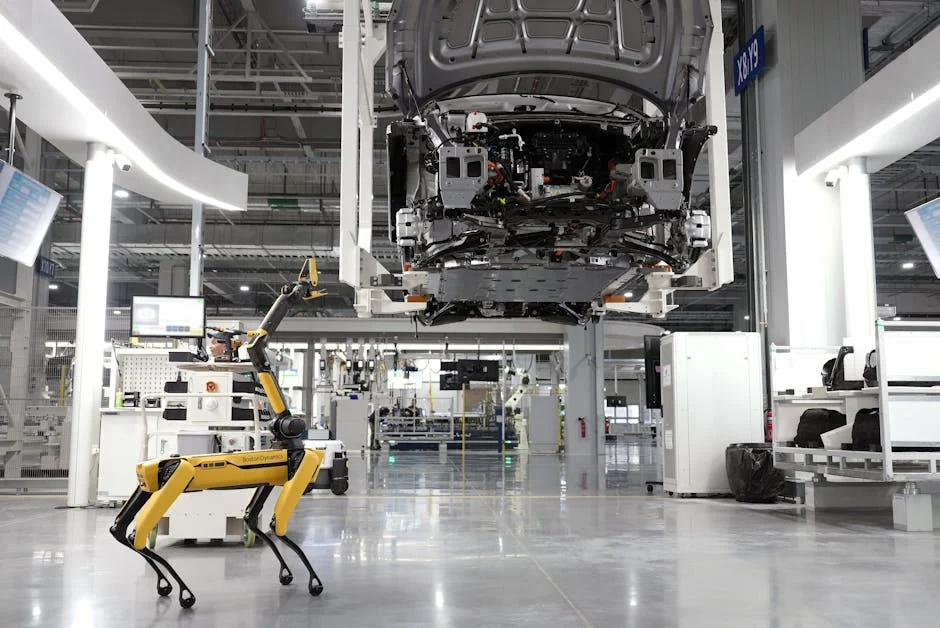
A robot dog is a four-legged robotic platform designed to mimic the gait, balance, and some behaviors of a real canine while delivering practical functions such as inspection, security patrol, mapping, or companionship. Unlike wheeled robots that struggle with stairs, curbs, rubble, and uneven ground, a robot dog uses articulated legs, sensors, and control algorithms to step over obstacles and keep moving when terrain changes unexpectedly. That ability to traverse complex environments is the core reason these machines have moved from novelty demos to serious tools. Many models combine cameras, depth sensors, inertial measurement units, microphones, speakers, and sometimes thermal imaging to perceive their surroundings. The onboard computer fuses that sensor data to maintain stability, plan footsteps, avoid collisions, and respond to commands from a handheld controller or a remote operator. Some units also integrate mapping technologies so they can build a representation of a facility, track where they have been, and return to a docking station for charging. The most advanced versions can operate semi-autonomously with preplanned routes, safety rules, and geofencing, while still allowing human oversight when conditions change. Because they are essentially mobile sensor platforms, the value often comes less from the “dog” form factor and more from the combination of mobility plus perception, which enables data collection in places that are awkward, risky, or time-consuming for people.
Table of Contents
- My Personal Experience
- What a Robot Dog Really Is and Why It Matters
- How a Robot Dog Walks: Balance, Gait, and Control Systems
- Sensors and Onboard Intelligence: Seeing, Hearing, and Measuring the World
- Everyday Use Cases: Security Patrols, Inspections, and Telepresence
- Robot Dog in Healthcare, Elder Care, and Assisted Living Settings
- Education and Research: A Platform for Robotics Skills and AI Experiments
- Expert Insight
- Buying Considerations: Cost, Payloads, Durability, and Total Ownership
- Safety, Privacy, and Ethical Deployment in Public and Private Spaces
- Robot Dog vs. Wheeled Robots and Drones: Choosing the Right Mobility
- Maintenance, Charging, and Long-Term Reliability in Real Deployments
- The Future of the Robot Dog: Smarter Autonomy and More Useful Payloads
- Watch the demonstration video
- Frequently Asked Questions
- Trusted External Sources
My Personal Experience
I met a robot dog for the first time at a local tech fair, and I didn’t expect it to feel so oddly familiar. It was about the size of a terrier, with smooth plastic panels and little motors that whirred softly when it moved. When I crouched down and held out my hand, it “sniffed” with a sensor and tilted its head in a way that made me laugh out loud. The handler let me try the controller, and I walked it in a slow circle—its steps were careful, almost cautious, like it was learning the floor. It didn’t have warmth or fur, obviously, but when it trotted back and sat on command, I caught myself smiling the same way I do when a real dog listens. On the drive home, I kept thinking about how quickly my brain filled in personality where there was really just code and gears.
What a Robot Dog Really Is and Why It Matters
A robot dog is a four-legged robotic platform designed to mimic the gait, balance, and some behaviors of a real canine while delivering practical functions such as inspection, security patrol, mapping, or companionship. Unlike wheeled robots that struggle with stairs, curbs, rubble, and uneven ground, a robot dog uses articulated legs, sensors, and control algorithms to step over obstacles and keep moving when terrain changes unexpectedly. That ability to traverse complex environments is the core reason these machines have moved from novelty demos to serious tools. Many models combine cameras, depth sensors, inertial measurement units, microphones, speakers, and sometimes thermal imaging to perceive their surroundings. The onboard computer fuses that sensor data to maintain stability, plan footsteps, avoid collisions, and respond to commands from a handheld controller or a remote operator. Some units also integrate mapping technologies so they can build a representation of a facility, track where they have been, and return to a docking station for charging. The most advanced versions can operate semi-autonomously with preplanned routes, safety rules, and geofencing, while still allowing human oversight when conditions change. Because they are essentially mobile sensor platforms, the value often comes less from the “dog” form factor and more from the combination of mobility plus perception, which enables data collection in places that are awkward, risky, or time-consuming for people.
Interest in the robot dog also reflects broader trends: labor shortages in inspection-heavy industries, the need for safer operations in hazardous sites, and the growing expectation that data should be collected continuously rather than through occasional manual checks. A patrol that once required a guard to walk a perimeter can be augmented by a robotic unit that streams video, logs anomalies, and repeats the same route with consistent coverage. In industrial environments, a robot dog can carry sensors to detect overheating components, gas leaks, or vibration signatures, potentially spotting issues earlier than a periodic human walkthrough. In public spaces, the same platform can be configured for simple tasks like guiding visitors, monitoring restricted areas, or providing telepresence. These uses raise important questions about privacy, safety, and accountability, but they also highlight why the category is expanding. The “robot dog” label captures public imagination, yet the practical conversation revolves around reliability, maintainability, and integration into real workflows. When the design is done well, the result is a tool that can reduce risk, extend human reach, and provide timely situational awareness without pretending to replace the judgment of trained professionals.
How a Robot Dog Walks: Balance, Gait, and Control Systems
Walking on four legs looks simple until you try to make a machine do it smoothly on a wet ramp, on gravel, or in a narrow hallway with tight turns. A robot dog typically relies on a combination of mechanical design and control software to remain stable. Mechanically, each leg contains multiple joints powered by electric motors, often paired with gear reductions to provide torque. Some designs use series elastic elements—components that add controlled flexibility—to absorb shocks and improve traction. The robot’s body houses batteries, computing hardware, and sensor arrays, and its mass distribution influences how easily it can recover from slips. On the software side, the system uses feedback loops that run many times per second, constantly adjusting joint angles based on sensor readings. An inertial measurement unit detects pitch, roll, and acceleration so the robot can correct itself if it begins to tip. Joint encoders report the position and speed of each motor, allowing the controller to coordinate leg motion precisely. Foot contact estimation helps determine whether a foot is planted or slipping, and that information guides the next step. When you see a robot dog climb stairs or step over a curb, you are watching a fast sequence of predictions and corrections that keep the center of mass within a stable region while the legs alternate between support and swing phases.
The gait of a robot dog can be tuned for different goals: speed, stability, energy efficiency, or quiet operation. A slow, cautious gait places a premium on stability, keeping more legs on the ground and reducing sudden movements. A faster trot may be appropriate for covering large areas quickly, but it demands more accurate state estimation and stronger actuators. Some platforms support multiple modes, switching automatically when the robot detects a slope or a rough surface. Navigation adds another layer: the robot must decide where to place its feet, not just where to send its body. In structured indoor environments, the system might rely on depth sensing and mapping to avoid obstacles and choose a path. Outdoors, it may need to handle changing lighting, mud, puddles, and debris. A robot dog that is marketed as “autonomous” usually includes a stack of technologies: localization to understand its position, perception to identify obstacles, planning to select a route, and control to execute that plan safely. Even with robust autonomy, most real deployments keep a human in the loop for safety and accountability. The better the control system, the more the robot dog feels predictable: it stops when it should, moves smoothly around people, and recovers from minor disturbances without dramatic stumbles.
Sensors and Onboard Intelligence: Seeing, Hearing, and Measuring the World
The usefulness of a robot dog is closely tied to the quality of its sensors and the way its software turns raw data into actionable information. Many units include a mix of RGB cameras for standard video, depth cameras or LiDAR for measuring distance, and an inertial measurement unit for motion tracking. Some models add thermal cameras to detect hotspots in electrical panels, motors, and HVAC equipment. Microphones can capture audio signatures, such as squealing bearings or unusual vibration noise. Environmental sensors may measure temperature, humidity, or the presence of specific gases. Because the robot is mobile, it can bring these sensors closer to assets that are difficult to access, capturing better readings than fixed sensors placed far away. The platform can also repeat the same route daily, collecting comparable data that supports trend analysis. That repeatability is valuable: it can be easier to notice a gradual temperature rise across weeks when the sensor position and viewpoint remain consistent. A robot dog can also capture data in places where installing fixed sensors is expensive, temporary, or impractical, such as construction sites or changing warehouse layouts.
Onboard intelligence determines whether the robot dog is merely a remote-controlled camera or a more capable autonomous inspection tool. Basic systems stream video to an operator who drives the unit like a small vehicle, relying on human judgment to spot issues. More advanced systems run edge computing workloads that detect anomalies, recognize objects, and flag conditions that require attention. For instance, a robot can compare a thermal image against a baseline and alert when a component exceeds a threshold. It can detect whether a door is open that should be closed, or whether a safety barrier is missing. Some solutions integrate with asset management platforms so inspection results can be logged automatically, creating a digital record with timestamps and location tags. Connectivity matters as well: Wi‑Fi may be sufficient indoors, but large facilities often require robust network planning, roaming support, and fallback behaviors if signal drops. When connectivity is limited, onboard processing becomes more important so the robot can navigate safely and store data until it reconnects. The best robot dog deployments treat sensor data as part of a workflow, not as a novelty feed. The robot becomes a consistent collector of evidence, and the organization benefits when that evidence is tied to maintenance actions, compliance reporting, or security response procedures.
Everyday Use Cases: Security Patrols, Inspections, and Telepresence
Many organizations adopt a robot dog because it can do repetitive rounds without fatigue and without exposing people to unnecessary risk. In security contexts, the robot can patrol perimeters, parking structures, or restricted indoor areas while streaming live video to a control room. It can follow a schedule, stop at checkpoints, and document what it sees. Some setups include two-way audio so a remote operator can speak through the robot, which can be useful for de-escalation or for giving instructions to a trespasser while keeping staff at a safe distance. In industrial inspection, a robot dog can walk routes through a plant, capturing thermal imagery of electrical cabinets, reading gauges, and checking for leaks or standing water. If the robot can climb stairs, it can reach mezzanines, platforms, and equipment rooms that would otherwise require ladders or careful human access. For facilities with multiple buildings, the ability to operate across mixed terrain—sidewalks, ramps, door thresholds—can turn a single platform into a versatile inspection assistant rather than a specialized gadget.
Telepresence is another practical application that benefits from a robot dog’s mobility. Instead of a static video call from a fixed conference room, a remote expert can “walk” through a site to inspect equipment, review a setup, or assist a technician. This can reduce travel time and enable faster problem resolution, especially when specialized expertise is scarce. In education and research, a robot dog can serve as a platform for experimentation in robotics, AI, and human-robot interaction. It can carry custom payloads, test navigation algorithms, or demonstrate control concepts in a tangible way. In entertainment and marketing, the same form factor can attract attention, but long-term value still depends on reliability and safety. Across these scenarios, the robot dog is most effective when it is treated as part of an operating model: clear routes, clear responsibilities for monitoring alerts, and clear procedures for maintenance and charging. Without those, the robot risks becoming an underused device that spends more time idle than productive. With thoughtful deployment, it can provide consistent coverage, better documentation, and a safer way to collect information from environments that are uncomfortable or dangerous for people.
Robot Dog in Healthcare, Elder Care, and Assisted Living Settings
In healthcare and assisted living, the idea of a robot dog often centers on companionship, engagement, and support rather than industrial inspection. Some robotic companions are designed to respond to touch, produce sounds, and offer interactive behaviors that can reduce loneliness and encourage social interaction. A robotic pet can be helpful in environments where real animals are not practical because of allergies, infection control policies, or staffing constraints. For certain residents, a robot dog can provide a predictable, low-risk form of engagement that encourages routine and conversation. It may also be used as a calming tool for people experiencing anxiety or agitation, especially when caregivers are trained to introduce it appropriately and monitor reactions. Importantly, these devices are not a substitute for human care; they are tools that can complement therapeutic programs and provide moments of comfort. The design priorities here differ from industrial models: soft materials, safe motion, quiet operation, and intuitive interaction can matter more than speed or payload capacity.
Beyond companionship, a robot dog can support telehealth workflows in limited ways when configured with cameras and communication tools, enabling remote family members or clinicians to connect. In some facilities, a mobile device can help staff check in on residents without constant room-to-room walking, though privacy and consent must be handled carefully. There is also growing interest in robots that can remind users about medications, guide simple exercises, or provide prompts that encourage hydration and movement. However, the benefits depend on implementation. Residents may respond differently based on personal preferences, cognitive state, and cultural attitudes toward robotics. Staff training is crucial to ensure the robot is used ethically and effectively, with clear boundaries and a focus on dignity. Any robot dog used in healthcare should be evaluated for safety certifications, data handling practices, and the ability to clean and disinfect surfaces. If cameras or microphones are involved, transparent policies and opt-in consent should be standard. When these considerations are addressed thoughtfully, a robot dog can become a supportive presence that adds variety and engagement to daily routines while respecting the human relationships at the center of care.
Education and Research: A Platform for Robotics Skills and AI Experiments
In academic and training environments, a robot dog can function as a hands-on platform for learning robotics in a way that textbooks alone cannot provide. Students can explore locomotion, kinematics, control theory, and sensor fusion by observing how a quadruped maintains balance while moving. They can test how changes in gait parameters affect stability and energy use, or how different terrain conditions influence slip and recovery. A physical robot exposes learners to real-world constraints: battery limits, motor heating, sensor noise, network latency, and the unpredictable nature of environments that are not perfectly controlled. Those constraints are often where the most valuable learning happens, because they mirror the challenges engineers face in production deployments. A robot dog can also support multidisciplinary projects that combine mechanical design, electrical engineering, computer science, and human factors. Teams can build attachments, integrate additional sensors, or develop user interfaces that allow safe operation by non-experts.
Expert Insight
Before buying a robot dog, define the primary use case—companionship, security patrol, or STEM learning—and match it to battery life, terrain capability, and sensor features. Test the control app for responsiveness and check whether replacement parts and firmware updates are readily available.
Set it up for success at home by creating a clear “play zone” free of loose cables and fragile items, then establish a simple routine: charge after each session, wipe down joints and feet, and run a quick calibration check weekly. Use consistent voice commands or button shortcuts to reinforce behaviors and reduce misfires. If you’re looking for robot dog, this is your best choice.
Research labs use quadruped platforms to explore autonomy, mapping, and interaction. A robot dog can navigate corridors, climb stairs, and traverse uneven outdoor surfaces, making it suitable for experiments in simultaneous localization and mapping, path planning, and reinforcement learning. Researchers may study how robots can interpret human gestures, follow a person at a safe distance, or operate in crowds without causing discomfort. Another area involves inspection automation: teaching a robot to recognize equipment, position itself consistently for data capture, and detect anomalies over time. Because a robot dog is mobile, it can gather datasets that include changes in lighting, weather, and occlusions—conditions that challenge computer vision systems. That makes it useful for developing robust perception models. Ethical considerations belong in education as well: students should learn about privacy, bias in data-driven models, and the responsibility of deploying mobile sensors in shared spaces. When used responsibly, a robot dog can be more than a flashy demo; it can be a serious educational tool that accelerates skills development in autonomy, embedded systems, and safe robotics engineering.
Buying Considerations: Cost, Payloads, Durability, and Total Ownership
Choosing a robot dog involves more than comparing headline specs. The purchase price is only one component; total cost of ownership includes batteries, charging docks, spare parts, software licenses, support contracts, and operator training. A key factor is durability: can the robot handle the surfaces and conditions where it will work? Some environments expose equipment to dust, moisture, temperature swings, or chemical residues. Ratings for ingress protection, stated operating temperatures, and cleaning procedures matter. Payload capacity is another deciding point. A robot dog might need to carry a thermal camera, a LiDAR unit, a gas sensor, a radio for indoor coverage, or a small manipulator. Each payload affects runtime, stability, and the ability to climb stairs. Battery life should be evaluated in realistic conditions, not just in ideal lab tests. If the robot spends time standing, streaming video, and processing sensor data, the runtime may differ from continuous walking benchmarks. Consider how long a typical route takes, how often the robot must recharge, and whether a spare battery strategy is feasible.
| Robot dog type | Best for | Key features |
|---|---|---|
| Companion robot dog | Home interaction & emotional support | Voice responses, touch sensors, expressive sounds/movements, app control |
| Educational / STEM robot dog | Learning coding & robotics | Programmable behaviors, modular parts, tutorials/curriculum support, safe indoor use |
| Professional / inspection robot dog | Site patrol, mapping & hazardous inspections | Autonomous navigation, cameras/LiDAR, rugged build, payload mounts for sensors |
Software and integration often determine whether the robot dog delivers real operational value. Some buyers need an open development kit to build custom behaviors and integrate with existing systems. Others prefer a turnkey solution with prebuilt inspection routines, reporting dashboards, and maintenance workflows. Autonomy features should be assessed carefully: does the robot require markers, pre-mapped environments, or constant connectivity? How does it behave when it encounters a blocked path, a closed door, or a crowd? Safety features such as emergency stop mechanisms, speed limits near people, and collision avoidance should be evaluated through demonstrations in representative settings. Support and serviceability are also critical. If a leg actuator fails, how quickly can it be repaired, and what is the downtime? Are parts readily available? Is there a local service partner? Procurement teams should also consider data governance. A robot dog that captures video and maps may store sensitive facility layouts; understanding where data is stored, who can access it, and how long it is retained is essential. The best buying decision aligns the platform’s strengths with a clear use case, measurable success criteria, and an operational plan for daily use, maintenance, and oversight.
Safety, Privacy, and Ethical Deployment in Public and Private Spaces
A robot dog can create safety benefits by keeping people away from hazards, but it also introduces new risks that must be managed. Physical safety starts with predictable motion and conservative speed limits in shared spaces. Operators should define where the robot is allowed to travel, how it yields to pedestrians, and how it handles narrow corridors or doorways. Emergency stop procedures should be clear, and staff should be trained to intervene if the robot behaves unexpectedly. Risk assessments should consider tripping hazards, collisions, and the possibility of the robot falling on stairs. In industrial settings, the robot might enter areas with moving machinery, forklifts, or high-voltage equipment, which requires careful route planning and coordination with site safety policies. If the robot dog is used outdoors, weather and surface conditions become part of safety planning: wet leaves, ice, and loose gravel can change traction and stopping distance. Responsible deployment includes testing in the real environment, not just relying on manufacturer claims.
Privacy and ethics are equally important because a robot dog is often a mobile sensor platform that captures video, audio, and spatial maps. In workplaces, employees should be informed about what data is collected, why it is collected, and how it will be used. Clear signage may be appropriate in areas where the robot patrols. Data minimization is a practical principle: collect only what is needed for the purpose, store it securely, and retain it for a defined period. Access controls should ensure that only authorized personnel can view recordings or live feeds. In public-facing deployments, the presence of cameras can make people uneasy, so transparency and visible policies help reduce friction. Ethical concerns also include how the robot is used in security contexts. If it is deployed as a deterrent, organizations should avoid creating an atmosphere of intimidation and should ensure the robot’s role is proportionate to the risk. The robot dog should not be treated as a decision-maker for enforcement actions; human judgment and accountability remain necessary. A thoughtful approach considers community expectations, legal requirements, and the long-term trust implications of deploying a mobile, camera-equipped machine in spaces where people live, work, or gather.
Robot Dog vs. Wheeled Robots and Drones: Choosing the Right Mobility
A robot dog is not always the best tool, and comparing it with alternatives helps clarify when legged mobility is worth the added complexity. Wheeled robots are often simpler, cheaper, and more energy-efficient for flat indoor floors. They can carry heavier payloads relative to their size and may offer longer runtimes because rolling typically consumes less energy than walking. In warehouses with smooth surfaces and ramps, a wheeled platform can be a strong choice. However, wheels struggle with stairs, high thresholds, and uneven outdoor terrain. If the environment includes frequent steps, debris, or surfaces that change quickly, the robot dog’s ability to lift its feet and adjust stance becomes valuable. Quadrupeds can also reposition their body to keep sensors stable, which can improve inspection image quality in cluttered areas. That said, legged platforms often require more maintenance because they have more moving parts, and they may be noisier depending on actuator design.
Drones offer a different advantage: access to elevated viewpoints and the ability to inspect roofs, towers, and hard-to-reach structures without ground obstacles. For certain inspections, an aerial drone can capture data faster than a ground robot. But drones have limitations: shorter flight times, regulatory constraints, higher operational risk in indoor spaces, and challenges around safe operation near people. Indoors, GPS may be unavailable, and airflow can be turbulent near machinery. A robot dog can operate longer and can carry sensors close to ground-level equipment, under pipes, or through narrow corridors where drones may be unsafe. In many real operations, the best approach is a combination: a robot dog for routine ground patrols and close-range inspections, a wheeled robot for long hallways and predictable floors, and a drone for periodic aerial surveys. The decision should be driven by the environment, the data needed, safety requirements, and the cost of building a reliable operational routine. Mobility is a means to an end, and the most effective teams choose the platform that gathers the right information with the least risk and friction.
Maintenance, Charging, and Long-Term Reliability in Real Deployments
Long-term value from a robot dog depends on reliability and the discipline of maintenance. Quadruped robots have multiple actuators, joints, and sensors that must remain calibrated and functional. Routine checks may include inspecting foot pads for wear, verifying joint performance, cleaning camera lenses, and testing emergency stop systems. Firmware and software updates can improve stability and security, but they must be managed carefully to avoid unexpected behavior changes in production environments. Battery health is a major factor. Lithium-based batteries degrade over time, especially if they are frequently charged to 100% or left at very low charge for long periods. A practical charging strategy may involve scheduled docking, spare battery rotation, and monitoring battery cycles. If the robot dog is used in demanding conditions, keeping spare parts on hand—such as protective covers, foot pads, or joint components—can reduce downtime. The maintenance plan should be aligned with how critical the robot’s role is; a unit used for occasional demos can tolerate downtime, but a unit used for daily inspection routes needs a more rigorous approach.
Charging infrastructure affects usability. A docking station placed in a convenient, safe location can make routine operations smoother, allowing the robot to return and charge automatically between tasks. The docking area should have reliable connectivity if uploads or updates occur there, and it should be protected from heavy traffic that could block access. Reliability also depends on environment readiness: consistent lighting for vision-based navigation, network coverage for remote monitoring, and clear policies for doors and access points. A robot dog may be technically capable of navigating a route, but if a door is often left closed or a hallway is frequently cluttered, autonomy will suffer unless workflows adapt. Organizations that succeed with robot deployments often treat the robot like a team member with a schedule and support, not like a gadget that is turned on occasionally. They define route ownership, alert handling procedures, and performance metrics such as route completion rate, anomaly detection accuracy, and mean time between failures. Over time, the robot’s role can expand as confidence grows. With consistent maintenance, careful environment tuning, and clear operational ownership, a robot dog can remain useful beyond the initial novelty phase and become a dependable part of monitoring, inspection, or security routines.
The Future of the Robot Dog: Smarter Autonomy and More Useful Payloads
The next phase of robot dog development is likely to focus on making these platforms more useful and less demanding to operate. Improvements in autonomy will aim to reduce the amount of manual setup required for navigation, mapping, and route management. Better perception can help robots handle dynamic environments where people, carts, and temporary obstacles appear frequently. More robust localization methods may reduce dependence on perfect lighting or highly structured spaces, enabling consistent performance across day and night shifts. On the manipulation side, some robot dog designs are being paired with small arms or specialized payloads that can press buttons, open simple latches, or place sensors against surfaces for better readings. That kind of capability can turn a passive inspection platform into an interactive maintenance assistant, though it also introduces new safety and regulatory considerations. Audio analytics, thermal trend detection, and vibration analysis may become more integrated, allowing robots to provide higher-level insights rather than raw data streams.
Enterprise adoption will also depend on better tooling: easier fleet management, clearer audit logs, and stronger cybersecurity. As more organizations deploy mobile robots, managing user permissions, software updates, and data retention policies becomes essential. Interoperability with existing systems—security operations centers, maintenance management software, digital twins—can make a robot dog’s data more actionable. Another likely trend is specialization. Instead of one general-purpose robot that tries to do everything, there may be models optimized for specific industries: rugged units for outdoor infrastructure, quieter units for indoor public spaces, and companion-focused units for care environments. Regulations and public expectations will shape design as well, pushing manufacturers to provide clearer indicators when recording is active, better privacy controls, and safer default behaviors around people. Even with these advances, the most important factor will remain whether the robot dog solves a real problem. When the platform is paired with a clear workflow—what to inspect, how to respond to findings, and how to measure success—the robot dog becomes more than a headline. It becomes a practical tool that extends human capability while keeping humans responsible for decisions and outcomes.
A robot dog will continue to attract attention because it looks familiar and moves in a surprisingly lifelike way, but lasting impact comes from quiet, consistent performance: completing routes, capturing useful data, and operating safely around people and equipment. As autonomy improves and payload options expand, these machines will be able to handle more complex environments with less supervision, making them easier to justify beyond pilot programs. Organizations that approach deployment thoughtfully—balancing safety, privacy, maintenance, and integration—are the ones most likely to benefit as the robot dog category matures into a standard option for inspection, security support, research, and specialized assistance.
Watch the demonstration video
In this video, you’ll learn how a robot dog moves, balances, and responds to its surroundings using sensors and built-in software. It explains what the robot can do—like walking, turning, climbing, or following commands—and highlights real-world uses, from inspection and security to research and everyday assistance.
Summary
In summary, “robot dog” is a crucial topic that deserves thoughtful consideration. We hope this article has provided you with a comprehensive understanding to help you make better decisions.
Frequently Asked Questions
What is a robot dog?
A robot dog is a legged robotic device designed to mimic a dog’s movement and behavior, often used for education, entertainment, research, or inspection.
What can a robot dog do?
Depending on the model, this robot dog can walk or trot with ease, climb over small obstacles, follow your commands, stream live video, steer around hazards, and run custom routines through an app or SDK.
Are robot dogs safe to use at home?
Most consumer models are safe when used as directed, but a **robot dog** can still pinch fingers or trip people and pets if you’re not careful. Supervise children, keep hands and paws away from moving joints, and always follow the manufacturer’s safety guidelines.
How long does a robot dog battery last?
Most models run for roughly 30 to 90 minutes on a single charge, though a robot dog’s actual battery life depends on its size, how fast it moves, what it’s carrying, and power-hungry extras like cameras or Wi‑Fi.
Do robot dogs need internet or a subscription?
Many devices can handle basic controls offline, but cloud-powered extras—like voice assistants, remote access, and automatic updates—often need an internet connection and may come with optional subscription plans, especially for a robot dog.
How much does a robot dog cost?
Toy and educational robot dogs can cost roughly $50–$500, while advanced models for development or industrial use often range from several thousand to tens of thousands of dollars.
📢 Looking for more info about robot dog? Follow Our Site for updates and tips!

Trusted External Sources
- CARA – Aaed Musa
Jul 11, 2026 … The next robot dog I build will most likely be a smaller, more builder-friendly version of CARA, complete with a step-by-step build guide.
- Robot Dog – Amazon.com
Smart Robot Dog – Interactive STEM Pet with Voice Control, 30+ Actions & APP Programming, Durable Design for Kids Age 6+ (Compatible with iOS/Android).
- Robot Dog Go2_Quadruped_Robot Dog Company | Unitree Robotics
Unitree Go2 robot dog is equipped with 4D ultra-wide-angle LiDAR, creating a new species with body intelligence, Unitree quadruped (consumer-grade …
- Help me choose between 2 robot dogs – Reddit
May 11, 2026 … I settled on the highest equipment for both models: Hiwonder PuppyPi Pro Ultimate Kit + Raspberry Pie 5 8GB = $939.99 USD and Yahboom DOGZILLA S2 with … If you’re looking for robot dog, this is your best choice.
- Professional Robot Dogs – RobotShop.ca
Explore professional robot dogs with advanced quadruped mobility. Ideal for research, inspection, logistics, and robotics development …